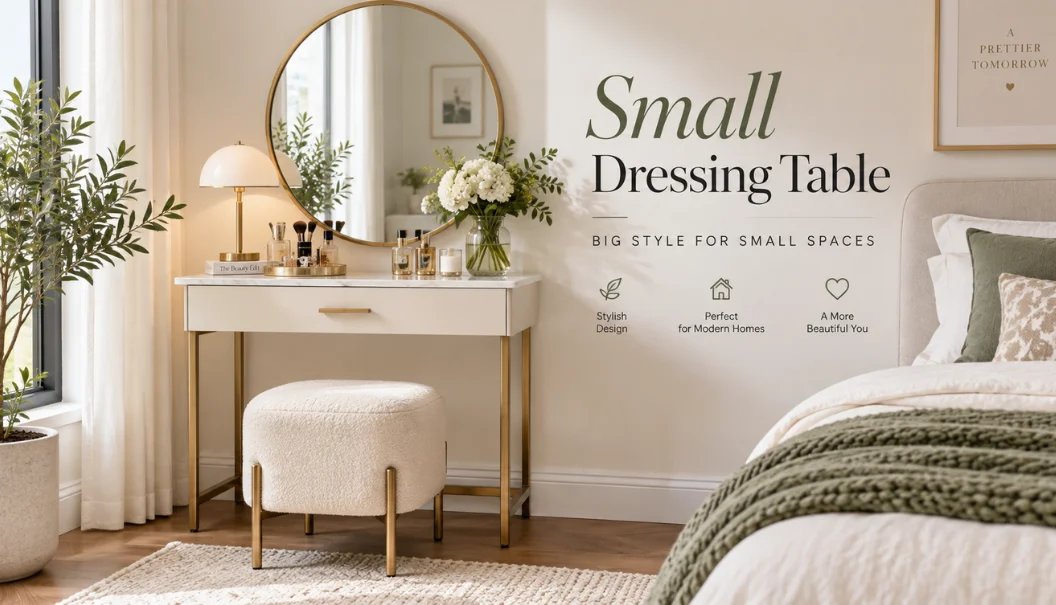
A small dressing table should save space without making your morning routine awkward. The right model fits the room, stores daily essentials, and leaves enough clearance for comfortable seating. In most UK bedrooms, dimensions matter more than decorative extras.
Quick answer: Measure the wall, floor depth, and chair clearance before comparing styles. Many compact models sit around 60–100cm wide and 35–45cm deep. Choose drawers for hidden storage and a wall mirror for a lighter look. Add a tuck-under stool to keep the walkway clear.
| Small Dressing Table | Practical guidance |
|---|---|
| Useful width | About 60–100cm for many compact designs |
| Useful depth | Around 35–45cm for many slim models |
| Typical surface height | Around 75–80cm |
| Seating clearance | Aim for at least 75cm where space allows. |
| Space-saving mirror | Wall-mounted or lift-up designs |
| Storage priority | Drawers for clutter, shelves for quick access |
| Smart placement | Near natural light without blocking movement |
| Current UK prices | Roughly £60 to £300+ across mass-market and premium examples |
Key Takeaways
- Measure width, depth, and seated clearance before choosing a style.
- A 70–80 cm-wide model often suits box rooms and smaller double bedrooms.
- Wall-mounted mirrors keep the surface clearer and can make the setup look lighter.
- A stool that slides underneath protects valuable walking space.
- Drawers work better than open shelves when visual clutter is the main problem.
- LED mirrors help in dark corners, but natural light remains useful for daytime grooming.
What Counts as a Compact Vanity in a UK Bedroom?
Current UK ranges show that compact designs vary more than the label suggests. Furniture in Fashion uses roughly 60–100cm wide and 35–45cm deep as a practical compact range. Retailers also sell narrower models for tighter corners.
Real products show how much dimensions can differ. IKEA’s BRIMNES is 70cm wide and 42cm deep, while Dunelm’s Olney is 75cm wide and 50cm deep. That depth difference can change how easily you get past the furniture.
How to Choose a Small Dressing Table That Actually Fits
Measure the room before looking at colors, handles, or mirror shapes. Record the clear wall width and the furniture depth you can accept. Then check how far a stool must move for comfortable use.
Use a simple three-measure test before buying:
- Wall width: leave a little breathing space beside wardrobes, sockets, and door frames.
- Furniture depth: check the top depth plus handles, mirrors, or projecting shelves.
- Seated clearance: allow about 75cm where possible, with more space for easier movement.
The third measurement is often missed in compact bedrooms. A slim unit can still feel cramped when the stool blocks the main route. Writiva’s small bathroom ideas guide uses the same movement-first principle for tight rooms.
Which Compact Style Makes the Most Sense?
Different layouts need different furniture shapes. A narrow wall, dark corner, or shared work area each creates a different priority. Compare the format before comparing finishes.
| Style | Good for | Pros | Cons |
|---|---|---|---|
| Slim console vanity | Narrow walls and simple routines | Light footprint, flexible mirror choice | Limited storage |
| Lift-up mirror vanity | Clutter-prone rooms | Hidden mirror, concealed compartments | Surface access changes when opened. |
| Corner vanity | Unused corners | Uses awkward space, keeps main walls free | Can be harder to light evenly |
| LED mirror vanity | Dark rooms and evening routines | Built-in task lighting, clear reflection | Needs a socket and cable planning |
| Desk-and-vanity hybrid | Bedrooms serving two purposes | Replaces two furniture pieces | Needs clear knee space and enough depth |
Our recommendation is to start with the room problem, not the furniture trend. Choose a slim console when movement is tight or hidden storage when clutter is the issue. Pick an LED model only when the lighting solves a real need.
What Should You Expect to Pay in the UK?
Prices vary sharply by material, storage, lighting, and brand. On 20 September 2026, IKEA listed BRIMNES at £69, with a 70cm by 42cm footprint. Dunelm listed compact examples around £119 to £179, depending on design and mirror features.
Marketplace models can start lower, especially with engineered wood and integrated LEDs. Tesco recently listed a compact HOMCOM model around £63, while Wayfair showed a similar version near £66. Solid oak and premium finishes can go well above £300.
Treat those figures as current examples rather than fixed price bands. Sales, stock, delivery, and finish choices can change the final cost. Compare dimensions first, because a cheap unit is poor value if it blocks the room.
Storage: Drawers, Shelves, or Hidden Compartments?
Drawers suit people who want the surface to stay visually calm. They hide brushes, cosmetics, jewelry, and charging cables without adding more containers. Shallow drawer dividers also stop small items from becoming a mixed pile.
Lift-up tops combine a mirror with hidden storage beneath the surface. This can work well when you want a cleaner look between uses. Check hinge clearance, because bottles may need to move before the top closes.
Mirror and Lighting Choices for Small Bedrooms
Natural light is useful when the layout allows it. A position facing or near a window gives more even daytime light than a dark wall. Avoid creating glare by placing the mirror directly opposite harsh afternoon sun. Built-in LEDs can help when the only available corner is dim. Look for adjustable brightness and color temperature, not just decorative bulbs. A nearby socket also keeps extension leads away from the main walkway.
Where Should You Put It in a Small Room?
Start with the walking route between the bed, wardrobe, door, and window. Furniture shouldn’t make you turn sideways every time you cross the room. A free wall, alcove, or quiet corner usually works better than a busy passage. Check nearby radiators before committing to the position. Writiva’s radiator shelf guide explains why heating areas need airflow and sensible clearance.
Keep cosmetics, aerosols, and heat-sensitive items away from strong heat sources. If the wall needs visual treatment, keep the background simple. Writiva’s wood panelling guide notes that scale and colour affect how compact a room feels. Light finishes and restrained patterns can stop a small getting-ready zone from looking crowded.
Can the Same Furniture Work as a Desk?
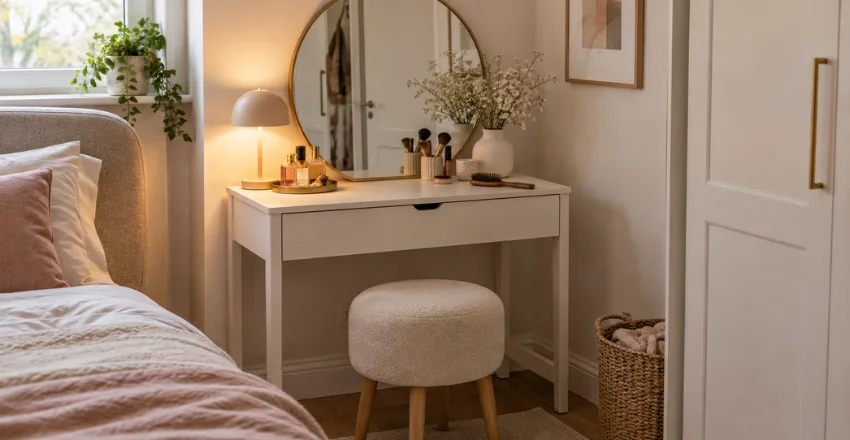
Yes, if the top is deep enough and the center has clear legroom. A laptop setup usually needs more usable depth than a simple grooming routine. Around 40–45cm can work for light tasks, though larger screens may need more distance.
Choose a removable or wall-mounted mirror when desk use matters. If storage allows, keep one drawer for work items and another for personal items. Cable clips can stop chargers from spreading across the surface. Do not treat every vanity as an ergonomic workstation. Deep center drawers can reduce knee clearance, while shallow tops can push a screen too close. A proper desk remains better for long working sessions.
Mistakes That Make Compact Furniture Feel Bigger
Small rooms punish measurement mistakes quickly. The wrong shape can block a drawer, wardrobe door, radiator, or walking route. Avoid these common problems:
- Buying from width alone and ignoring depth.
- Forgetting how far the stool pulls out.
- Choosing a large freestanding mirror for a shallow top.
- Filling open shelves with products that could live in drawers.
- Blocking sockets, heating controls, or wardrobe doors.
- Buying a matching stool that cannot tuck underneath.
- Assuming white furniture automatically makes a poor layout feel spacious.
Well-planned layouts preserve clear floor space around the furniture. A slightly smaller surface can be more useful than a larger top that obstructs movement. Measure the route through the room before deciding.
Verdict: Choose for the Room You Have
For most compact UK bedrooms, a 70–80 cm-wide vanity with drawers is a sensible starting point. Pair it with a tuck-under stool and a wall-mounted mirror when floor space is tight. Choose a lift-up mirror when hidden storage matters more than an always-ready surface.
Measure your wall, depth, and seated clearance before you shop. Compare two or three formats against those measurements, then choose the finish you like. That order keeps the purchase practical and reduces the chance of an expensive return.
Frequently Asked Questions
What size small dressing table suits a small bedroom?
A 70–80cm width works well in many smaller bedrooms, but the room decides the limit. Depth often matters more than a few extra centimeters of width. Measure the stool clearance as carefully as the furniture itself.
How deep should a compact vanity be?
Many compact models sit around 35–45cm deep. A wall-mounted mirror makes a shallower top easier to use. Freestanding mirrors and displayed products usually need more surface depth.
Where should it go in a small bedroom?
Place it where natural light and walking space work together. A free wall, alcove, or unused corner can all work well. Avoid blocking wardrobes, doors, radiators, or the main route around the bed.
Should the mirror be attached or wall-mounted?
A wall-mounted mirror usually gives more flexibility in a tight room. It frees surface space and lets you set the viewing height independently. An attached mirror is useful when wall fixing is unsuitable.
Can it be used as a desk?
Yes, when the top has enough depth, and the center has clear knee space. A removable mirror makes switching tasks easier during the day. Long work sessions still need a supportive chair and sensible screen distance.
Which storage style works in a tight room?
Drawers are a practical choice when visible clutter makes the room feel smaller. Open shelves suit daily essentials that stay neat and limited. Hidden lift-up storage works well when you want a clear surface between uses.