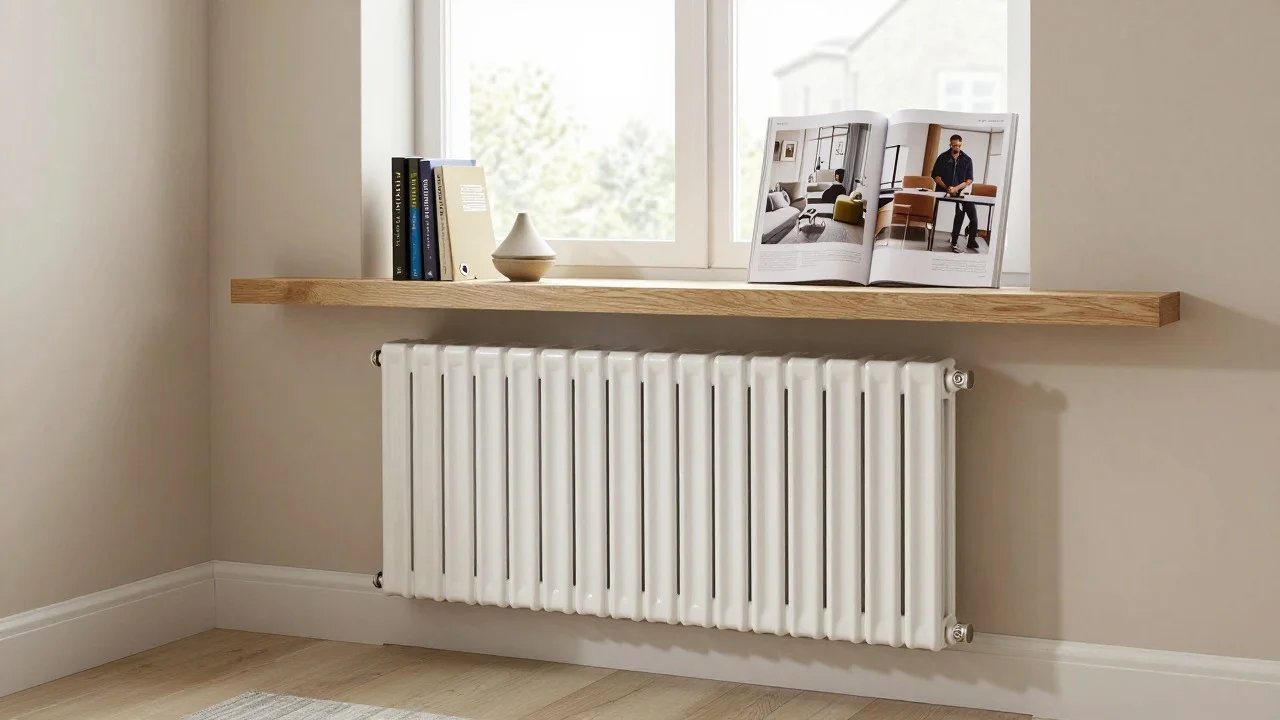
A radiator shelf turns an awkward patch of wall into useful display space without taking up extra floor area. It can work well in hallways, living rooms, bedrooms and other compact spaces. The key is choosing the right size and fitting method while leaving enough room for warm air to circulate.
Quick answer: A shelf above a radiator can provide useful display space and may help direct rising warm air further into the room. Choose a suitable material, follow the shelf and radiator manufacturers’ clearance guidance, measure carefully, and avoid filling the surface with items that dislike heat or restrict airflow.
| Key point | Practical guidance |
|---|---|
| Main purpose | Extra display space and a neater finish |
| Common materials | MDF, solid timber and engineered wood |
| Typical widths | Ready-made options commonly include 60, 90 and 120 cm sizes |
| Typical depth | Slim designs around 13 to 15 cm are widely available |
| Clearance | Follow manufacturer guidance; ordinary wall shelves need adequate airflow |
| Fitting choices | Wall-mounted, clip-on/no-drill or radiator-cover top |
| Good locations | Hallways, living rooms, bedrooms and under-window areas |
| Main concern | Avoid obstructing warm-air circulation |
Current UK retailer ranges show that slim shelves around 13 to 15 cm deep are common, while available widths vary considerably. Screwfix lists 600, 900 and 1200 mm examples, while other retailers offer broader size ranges.
What Does a Shelf Above a Radiator Do?
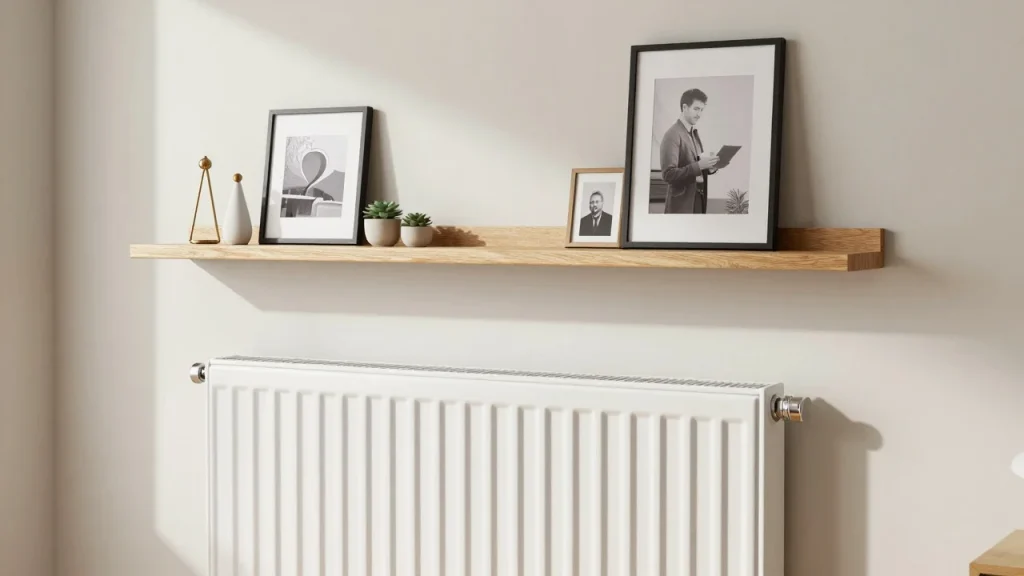
The most obvious benefit is space. Radiators often occupy a wall where a console table, cabinet or bookcase would be inconvenient. A narrow ledge gives you somewhere for photos, keys or decorative objects instead.
A correctly positioned shelf can also change the path of rising warm air. Retailers including B&Q and Screwfix describe their purpose as directing some warmth further into the room rather than straight up the wall.
That does not mean a shelf magically makes the heating system generate more heat. Its usefulness depends on positioning and airflow. Installing a solid surface too close to the top of a radiator can interfere with normal convection.
The idea can be especially useful beneath windows, where radiators are common in UK homes. If you’re looking at the wider thermal performance of windows as part of a room upgrade, Writiva’s coverage of aluminium windows and doors and thermal performance provides more context.
How to Choose the Right Radiator Shelf
Start with the radiator rather than the shelf you like online. Measure its visible width, its distance from the wall, and the available wall space around it.
Get the width in proportion.
A shelf that is much shorter than the radiator can look undersized. One that extends too far beyond it may dominate a narrow hallway.
You don’t have to match the radiator’s width exactly. A modest overhang on each side often creates a balanced appearance. Check nearby door frames, switches, curtains and furniture before deciding.
Keep the depth practical.
A shallow ledge suits most radiator positions. Current products from Argos, B&Q and other UK sellers commonly sit around 13 to 15 cm deep. That gives room for smaller objects without creating a bulky projection into the room.
Deeper isn’t automatically better. A large solid surface can dominate a small room and needs more careful consideration around airflow.
Leave enough clearance
There isn’t one gap that works for every shelf and every heating appliance.
Radiator-specific clip-on products are designed around their supplied brackets. Standard wall-mounted shelves need separate spacing. Wickes recommends keeping an ordinary shelf about six inches, or roughly 150 mm, above the radiator to reduce heat damage and preserve circulation. Always give the radiator and shelf manufacturers’ instructions priority.
Wall-Mounted, Clip-On or Radiator Cover?
| Type | Best suited to | Main advantage | Main consideration |
|---|---|---|---|
| Wall-mounted shelf | Permanent room updates | Strong, flexible positioning | Requires suitable wall fixings |
| Clip-on/no-drill shelf | Renters and quick updates | Little or no wall drilling | Must suit the radiator design |
| Radiator cover with top | Hiding an unattractive radiator | Changes the whole appearance | Needs adequate ventilation and clearance |
No-drill designs can be convenient. Argos describes a model that slots behind the radiator using supports, while Wayfair lists bracket-mounted products designed to fit without drilling into the wall.
A wall-fixed option gives you more freedom over height and width. It can also be the better choice if you need a stronger display surface, provided the fixings suit the wall construction.
Which Material Works Best?
MDF is common because it is affordable, smooth, and available in many finishes. Solid timber offers more natural character. Engineered boards can provide a consistent finish at a moderate price.
Heat exposure still matters. Wickes advises choosing heat-resistant materials or suitably treated timber and notes that some woods may distort if exposed to too much heat.
If a rustic timber look suits the room, Writiva’s guide to scaffold board shelves covers timber appearance, maintenance and bracket installation in more detail.
Paint can tie the ledge into the wall, radiator or surrounding joinery. White keeps the area discreet, while a contrasting wood tone makes it more noticeable. For a painted finish, Writiva’s Valspar colour matching guide explains how lighting, sheen and sample testing affect the final colour.
What Should You Put Above the Radiator?
Treat the surface as display space rather than unrestricted storage. Heat rises past it, so objects can become warmer and drier than they would elsewhere.
Good styling usually relies on a few lightweight pieces:
- framed photographs
- small ornaments
- keys or trays
- heat-tolerant decorative pieces
- seasonal items that can be moved easily
Avoid crowding the entire surface. Open space helps the arrangement look calmer and reduces the temptation to turn a narrow ledge into overloaded storage.
Be cautious with candles, wax products, batteries, aerosols, electronics, and anything carrying a warning about heat exposure. Delicate houseplants may also struggle in consistently warm, dry air.
Styling Ideas for Hallways, Living Rooms and Bedrooms
In a narrow hallway, keep the shelf slim and functional. A small tray for keys, one framed print, and a compact decorative object can replace the need for a deeper console table.
In a living room, treat it like a miniature mantel. A framed picture above the ledge can create a focal point without disguising the radiator completely.
Bedrooms benefit from a quieter approach. Neutral timber, soft wall colours and one or two simple objects prevent the heating area from looking cluttered.
For radiators beneath windows, resist filling the ledge with tall items that block light or interfere with curtains. A low arrangement usually makes the room feel less crowded.
The same principle works with bold radiators. Homebuilding’s 2025 design guide shows examples where simple timber ledges are paired with colourful radiators rather than hiding them.
Fitting Checks Before You Start
Check the radiator manufacturer’s instructions before attaching anything around the appliance. Make sure valves and controls remain easy to reach.
For a wall-mounted design, identify the wall construction and use the correct fixings. Wickes also advises checking for concealed pipes and cables before drilling. A spirit level is worth using because even a small slope is noticeable on a long, narrow ledge.
Clip-on products need different checks. Confirm that the brackets fit the space between the radiator and wall. Some made-to-measure systems, for example, specify a particular rear clearance range for their brackets.
Once fitted, run the heating and inspect the area. Check that the shelf isn’t becoming excessively hot, changing shape or interfering with curtains and nearby objects.
Make the Space Above Your Heating Work Harder
A well-chosen ledge can turn an awkward heating area into useful display space without adding another piece of furniture. Measure first, preserve airflow,, and choose a fitting system that suits both the radiator and wall.
FAQs
Follow the instructions supplied with both products because designs differ. For an ordinary wall-mounted shelf, Wickes recommends around 150 mm of clearance. Radiator-specific clip-on shelves use their own bracket spacing.
It shouldn’t when correctly sized and positioned. A shelf may direct rising warm air further into the room, but positioning it too close can restrict circulation.
Yes. Several UK retailers sell clip-on or easy-fit designs that attach using brackets around or behind suitable radiators. Check compatibility before ordering.
Potentially, but it must be mounted with enough clearance and suitable fixings. A radiator-specific product can be simpler because its intended positioning and brackets are already considered.
They make the most sense where floor space is limited, or the wall above the heating is otherwise unused. They also offer an inexpensive way to make a plain radiator area look more deliberate.