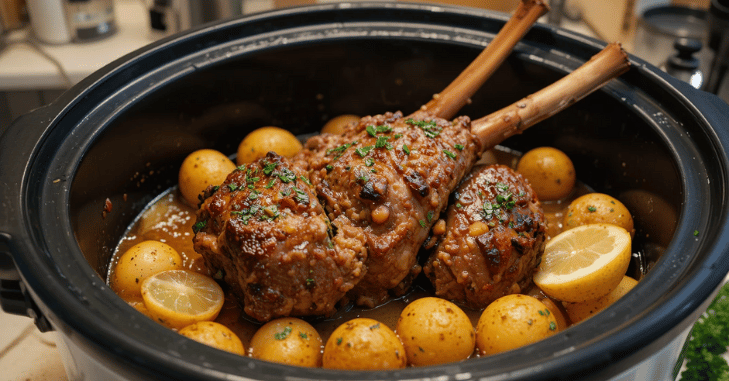
Kleftiko is a whole shoulder of lamb on the bone, marinated in lemon, garlic and oregano, sealed inside a parchment parcel with potatoes and cooked at a low temperature for four hours until the meat gives way under a spoon. The seal is the entire point: nothing evaporates, so the lamb effectively steams and braises in its own fat and juices while the potatoes underneath drink up the lot.
This is the traditional method rather than a weeknight shortcut. Active work is about 25 minutes, and everything after that is the oven’s problem. Below you will find exact quantities in metric and imperial, fan, conventional and gas mark temperatures, the tin size that actually fits a 2kg shoulder, and a troubleshooting table for the three things that most often go wrong.
At a glance
| Detail | Specification |
|---|---|
| Serves | 4 to 6 generously, with leftovers |
| Cut | Whole lamb shoulder, bone in, about 2kg (4lb 8oz) |
| Prep time | 25 minutes |
| Marinating | 4 hours minimum, ideally overnight (up to 24 hours) |
| Cooking time | 4 hours sealed, plus 20-25 minutes uncovered |
| Resting | 20 minutes before carving |
| Oven | 160C fan / 180C conventional / gas mark 4, then 200C fan / 220C conventional / gas mark 7 to finish |
| Tin | Deep roasting tin at least 35 x 28cm and 6cm deep |
| Also needed | Baking parchment and heavy-duty foil, or a lidded clay pot |
| Rough ingredient cost | Around £20-£25 for the whole dish |
Why it is called kleftiko, and why that matters to the method
The name comes from the klephts, the Greek irregulars and bandits of the Ottoman period who lived in the mountains. The story attached to the dish is that stolen lamb was cooked in a sealed pit dug into the ground, because an open fire would have sent up smoke and given the position away. Whether or not that is literal history, it explains the technique perfectly: no smoke, no steam, no smell escaping, and consequently a piece of meat cooked in a completely closed environment.
In Cyprus the dish is still associated with the wood-fired outdoor clay oven, which is bricked up and sealed with mud once the lamb goes in. A domestic oven cannot replicate the wood smoke, but it can replicate the seal exactly, and the seal is what produces the texture. If you take one thing from this recipe, take that: a leaky parcel gives you an ordinary roast shoulder. A tight one gives you kleftiko.
Choosing the lamb
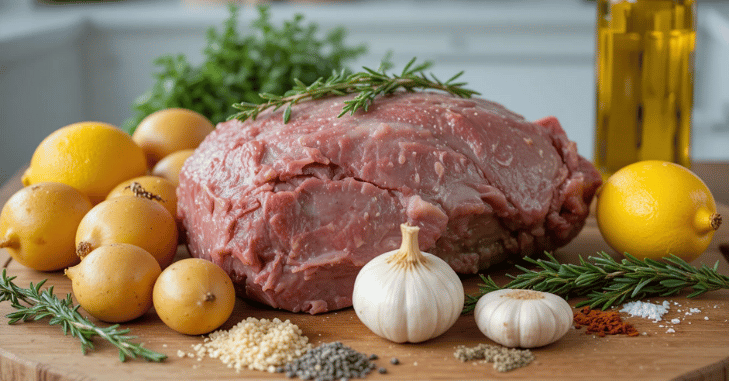
Ask for a whole shoulder on the bone. Not a leg, not a boned and rolled shoulder, not diced shoulder. Shoulder is the hardest-working muscle on the animal, so it is riddled with connective tissue and intramuscular fat, and four hours of low, moist heat turns all of that into gelatine. Leg has too little fat and goes dry and stringy over the same time. The bone matters too: it conducts heat gently into the centre of the joint and adds body to the juices.
On price, supermarket own-label bone-in shoulder generally works out somewhere around £8-£12 per kilo, with a whole Tesco shoulder joint sitting in the £13-£15 region recently. Waitrose British lamb shoulder, organic suppliers and independent butchers run considerably higher, roughly £14-£20 per kilo. A butcher will also let you specify weight, which is genuinely useful here, and will happily leave the bone in and the fat cap on. Do not let anyone trim the fat cap off – it bastes the joint for four hours and you can pull it away at the end.
New season British lamb appears from around Easter and runs through the summer; older hogget or mutton shoulder works beautifully in this dish too, but add an extra 45 minutes to an hour to the sealed cooking time.
Ingredients
For the lamb and marinade
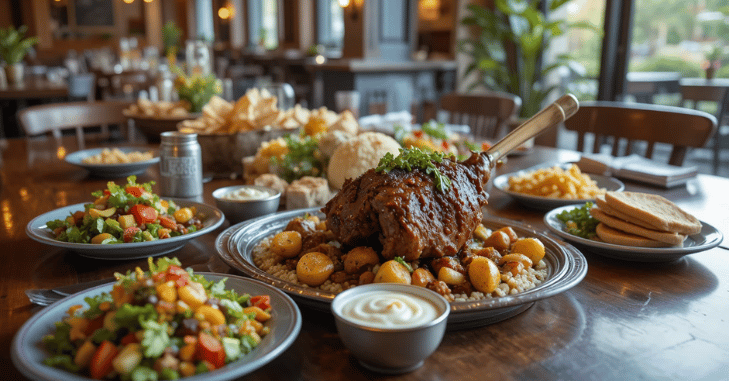
| Ingredient | Metric | Imperial | Notes |
|---|---|---|---|
| Lamb shoulder, bone in | 2kg | 4lb 8oz | Fat cap left on, scored in a diamond pattern |
| Garlic | 6 large cloves | 6 cloves | 4 sliced into slivers, 2 crushed |
| Lemons | 2 | 2 | Zest and juice of both, halves reserved |
| Extra virgin olive oil | 100ml | 3.5 fl oz | A Greek or Spanish everyday oil is fine |
| Red wine vinegar | 2 tbsp | 2 tbsp | Adds the sharpness that cuts the fat |
| Dried oregano | 2 tbsp | 2 tbsp | Greek rigani if you can get it – it is far more pungent |
| Fresh rosemary | 3 sprigs | 3 sprigs | Leaves stripped and roughly chopped |
| Bay leaves | 3 | 3 | Tucked under the joint |
| Ground cinnamon | 1 tsp | 1 tsp | Or one small cinnamon stick |
| Fine sea salt | 2 tsp | 2 tsp | Plus more for the potatoes |
| Black pepper | 1 tsp | 1 tsp | Freshly ground |
| Dijon mustard | 1 tbsp | 1 tbsp | Optional, helps the marinade cling |
For the parcel
| Ingredient | Metric | Imperial | Notes |
|---|---|---|---|
| Potatoes | 1kg | 2lb 4oz | Maris Piper or Charlotte, peeled, cut into 5cm chunks |
| Red onions | 2 large | 2 large | Cut into thick wedges |
| Cherry tomatoes | 200g | 7oz | Optional, left whole |
| Dry white wine | 150ml | 5 fl oz | Or lamb stock, or water with a squeeze of lemon |
| Feta | 100g | 3.5oz | Crumbled over at the very end, off the heat |
Maris Piper gives you fluffy potatoes that partly break down and thicken the juices. Charlotte or another waxy variety holds its shape and stays glossy. Both are correct; pick the texture you want. Whatever you use, cut the chunks large – 5cm or so – because small pieces disintegrate completely over four hours.
Method
Step 1: marinate, the day before
- Score the fat cap in a diamond pattern, cutting through the fat but not into the meat. Use the tip of a small knife to make about a dozen deep incisions all over the joint.
- Push a sliver of garlic and a few rosemary leaves into each incision.
- Whisk together the olive oil, lemon juice and zest, vinegar, crushed garlic, oregano, cinnamon, mustard if using, salt and pepper.
- Rub the marinade over every surface of the lamb, working it into the scored fat. Put the joint in a large dish or a strong bag, cover, and refrigerate for at least 4 hours and ideally overnight.
- Take the lamb out of the fridge 1 hour before it goes in the oven. A fridge-cold 2kg joint will otherwise skew all your timings.
Step 2: build the parcel
- Heat the oven to 160C fan / 180C conventional / gas mark 4.
- Line a deep roasting tin with two long, overlapping sheets of baking parchment, letting plenty overhang on all sides. Lay two equally long sheets of heavy-duty foil underneath the parchment if your tin is shallow – the foil is the structural layer, the parchment stops the acidic marinade meeting the metal.
- Tumble the potatoes, onions and tomatoes into the base with the bay leaves and a good pinch of salt. Pour over the wine.
- Sit the lamb on top, fat side up, and scrape every last bit of marinade over it. Add the squeezed lemon halves to the tin.
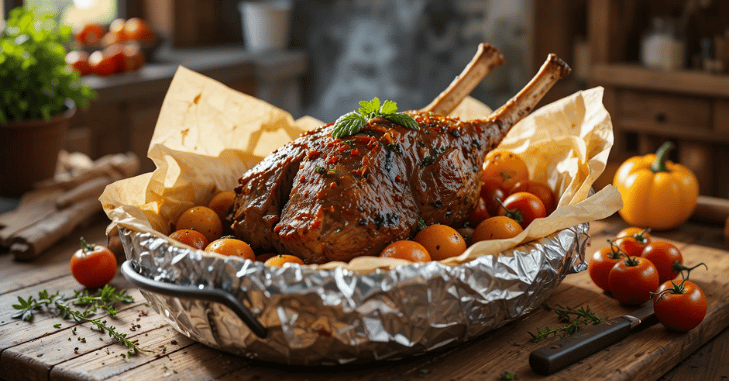
- Bring the parchment up over the joint and fold the edges together in tight pleats, then do the same with the foil, sealing the parcel completely. It should look like a sealed pillow with no gaps at the corners. Do not let the covering touch the top of the fat cap if you can avoid it – leave a little headroom for steam to circulate.
Step 3: the long cook
- Cook sealed for 4 hours. Do not open it, do not baste it, do not check on it at two hours. Every time you open the parcel you lose the accumulated steam that is doing the work.
- After 4 hours, open the parcel carefully – the steam that comes out is genuinely scalding – and check the meat. It should be pulling away from the bone with almost no resistance. A probe thermometer should read 90-95C in the thickest part. That is far past pink; you want collapse, not medium-rare.
- If it is not there yet, reseal and give it another 30-45 minutes.
- Turn the oven up to 200C fan / 220C conventional / gas mark 7, leave the parcel open, and roast for a further 20-25 minutes to brown and crisp the fat cap and colour the potatoes.
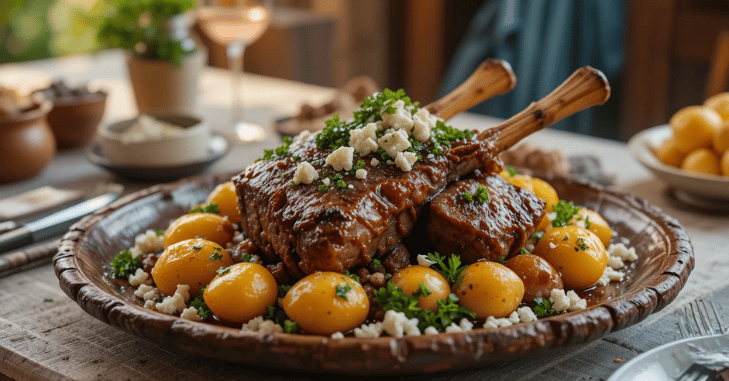
- Rest the lamb, loosely covered, for 20 minutes. Crumble the feta over the potatoes while everything is still hot, and squeeze over the roasted lemon halves.
Serve it at the table straight from the tin, pulled apart with two forks. Kleftiko is not a carving dish and no one expects neat slices.
Cooking times for other joint sizes
| Joint weight | Sealed at 160C fan | Uncovered at 200C fan | Serves |
|---|---|---|---|
| 1.2-1.4kg (half shoulder) | 3 hours | 15-20 minutes | 3-4 |
| 1.8-2kg (whole shoulder) | 4 hours | 20-25 minutes | 4-6 |
| 2.5kg (large shoulder) | 4 hours 45 minutes | 25 minutes | 6-8 |
| Hogget or mutton, 2kg | 5 hours | 25 minutes | 4-6 |
| Leg of lamb, 2kg | 3 hours 15 minutes | 15 minutes | 6 – drier, use only if you cannot get shoulder |
Doing it in a clay pot, a casserole or a slow cooker
A clay pot (a Greek gastra, a Romertopf or a similar unglazed lidded pot) is the closest thing to the original. Soak the pot and lid in cold water for 20 minutes, load it cold, and put it into a cold oven, then bring the oven up to temperature – clay hates thermal shock. Timings are the same, but you can skip the parchment because the lid seals well enough on its own.
A heavy lidded casserole works too, though a 2kg shoulder plus a kilo of potatoes needs at least a 6.5 litre pot. Lay a sheet of parchment under the lid to improve the seal.
A slow cooker will produce tender lamb but not kleftiko, because you cannot get the browning and the potatoes end up watery. If you want to use one, cook on low for 8 hours or high for 5, then transfer the joint to a hot oven at 200C fan for 20 minutes to finish, and roast the potatoes separately.
Common problems and how to fix them
| What went wrong | Why it happened | The fix |
|---|---|---|
| Meat is tough and chewy after 4 hours | It is undercooked, not overcooked. Collagen has not broken down yet. | Reseal and keep going in 30-minute stages. Shoulder cannot be rushed, and the target is 90-95C internal, not a time on a clock. |
| Meat is dry and stringy | Wrong cut (leg or boned shoulder), or the parcel leaked. | Use bone-in shoulder and check every corner of the seal before it goes in. Pour the tin juices back over the shredded meat to rescue it. |
| Potatoes are watery and pale | Too much liquid, or they were cut too small. | Stick to 150ml of wine and 5cm chunks. Give them the full 25 minutes uncovered at the end. |
| Everything is greasy | A very fatty shoulder rendering into a sealed tin. | Spoon or blot the surface fat off before the uncovered phase, or chill the juices and lift the set fat off if you are cooking ahead. |
| Not enough juice to serve | Parcel was not sealed properly and it evaporated. | Add 100ml of hot stock to the tin during resting and scrape the base. |
| Tastes flat | Under-salted, or not enough acid. | Salt the potatoes properly and finish with lemon. The roasted lemon halves squeezed over at the end make a bigger difference than people expect. |
Substitutions that work
- No wine: use lamb or chicken stock, or water with an extra tablespoon of lemon juice.
- No feta: a firm Cypriot cheese such as kefalotyri or halloumi cut into cubes and buried among the potatoes is closer to the Cypriot original than crumbled feta anyway.
- No fresh rosemary: dried thyme works, but never substitute dried rosemary – it stays woody.
- Potato swaps: half potatoes and half chunks of aubergine or courgette, added for the last 90 minutes only so they do not turn to mush.
- No cinnamon: leave it out rather than replacing it. It is a quiet background note in the Cypriot version, not a headline flavour.
- Garlic: use fresh cloves rather than a jar of paste for this. Whole bulbs keep for months in a cool, dry place – here is how long garlic actually lasts and how to store it.
Make ahead, leftovers and freezing
- Marinate up to 24 hours ahead. Beyond that the lemon juice starts to cure the surface of the meat and the texture turns slightly chalky.
- Cook a day ahead: complete the 4-hour sealed stage, cool, refrigerate in the tin, then bring back to room temperature and do the uncovered 25 minutes before serving. This is the easiest way to serve kleftiko to guests without watching a clock all afternoon.
- Leftover meat keeps in the fridge for 3 days. Shred it, cover it with its own juices, and it will not dry out.
- Freezing: shredded meat freezes well for up to 3 months in its juices. The potatoes do not – they go grainy. Defrost overnight in the fridge and reheat covered at 160C fan until steaming hot throughout.
- Second-day ideas: pile the shredded lamb into warm pitta with tzatziki and red onion, or fold it through orzo with the reheated juices.
What to serve with kleftiko
The lamb and potatoes are already a complete plate, so everything else should be sharp, fresh and cold to cut through four hours of rendered fat.
- Horiatiki – the proper Greek village salad: tomato, cucumber, green pepper, red onion, olives, a slab of feta, oregano and olive oil. No lettuce.
- Tzatziki made with thick Greek yoghurt, grated and squeezed cucumber, garlic and mint.
- Warm pitta or flatbread for mopping the tin.
- Green beans in tomato and olive oil (fasolakia), which can share the oven at the low temperature.
- A green vegetable side if you are serving it as a Sunday alternative to a British roast – something like cheesy leeks sits surprisingly well next to the lemon and oregano.
- To drink: a Greek Agiorgitiko or Xinomavro, a Cypriot Maratheftiko, or a straightforward Rioja crianza.
For pudding, keep it warm and unfussy – something like a classic apple crumble can go in while the lamb rests, and if you are cooking this instead of a traditional roast you will not miss Yorkshire puddings for a single second.
Six things that separate a good kleftiko from a great one
- Marinate overnight. Four hours is the minimum, not the target.
- Score the fat and stud the meat with garlic, rather than just rubbing the outside.
- Seal the parcel properly. Pleat and fold the edges twice; a single loose fold will vent.
- Cook to temperature, not to time. 90-95C internal is the number that matters.
- Do the uncovered blast at the end. Skipping it gives you pale, flabby fat and disappointing potatoes.
- Rest for a full 20 minutes and squeeze the roasted lemons over everything before it reaches the table.
While Jamie Oliver has shared many Mediterranean and Greek-inspired lamb recipes, he does not have a widely published or official lamb kleftiko recipe.
It comes from klephts, Greek rebels and bandits who cooked meat in hidden pits to avoid detection during Ottoman rule.
Lamb shoulder is ideal for its fat content and tenderness. Lamb leg can also be used for a leaner option.
James Martin and Rick Stein have recipes inspired by the techniques of kleftiko. Jamie Oliver doesn’t have an official kleftiko recipe, but his slow-roasted lamb dishes are similar in style.