


The Mary Berry approach to Yorkshire puddings is built on one idea that solves most of the problems people have with them: measure by volume rather than by weight, using equal amounts of egg, plain flour and milk. Crack the eggs into a measuring jug, note the level, then add the same volume of flour and the same volume of milk. Four medium eggs come to roughly 200ml, so you want about 200ml of flour (around 115g) and 200ml of milk. For a closer look, see Ultimate Guide to Adidas SL72 Trainers.
Everything else is technique, and there are only three pieces of it: rest the batter, get the fat genuinely smoking before the batter goes near it, and do not open the oven door. What follows is that method written out properly, in my own words, with tin sizes, fan and gas temperatures, scaling for two people or eight, and a troubleshooting table for the two failures everyone recognises – the pudding that never rose and the one that rose beautifully and then sank on the way to the table.
At a glance
| Detail | Specification |
|---|---|
| Makes | 12 small puddings, or 4 large ones |
| Prep | 10 minutes |
| Resting | 30 minutes minimum, up to 24 hours in the fridge |
| Bake | 20-25 minutes (small), 25-30 minutes (large) |
| Oven | 220C fan / 240C conventional / gas mark 9 |
| Tin | 12-hole non-stick bun or muffin tin, or a 4-hole Yorkshire pudding tin |
| Fat | Beef dripping, lard, or sunflower or rapeseed oil – never olive oil |
| Core ratio | Equal volumes of egg, plain flour and milk |
| Rough cost | Under £1 for a batch of 12 |
| Freezes | Yes – up to 1 month, reheated straight from frozen |
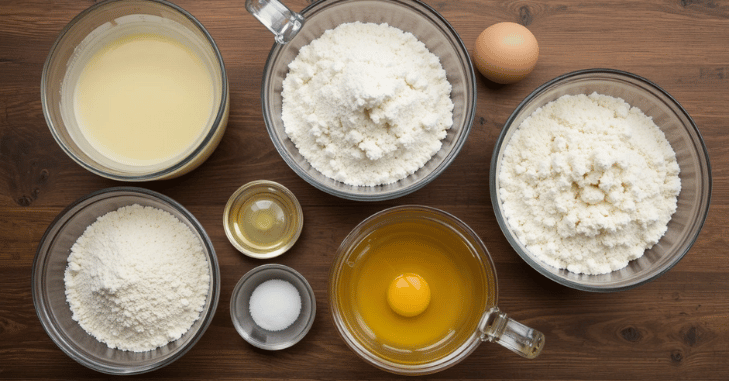
Why the equal-volume method works
Most Yorkshire pudding recipes give you grams of flour and millilitres of milk, and then tell you to use two or three eggs regardless of what size those eggs happen to be. British medium eggs vary by a good ten grams between the small end and the large end of the box, which is enough to shift a batter from correct to too thin. Measuring the eggs first and matching everything else to them removes that variable completely, whichever eggs you have.
The ratio itself is doing real work. Egg provides protein that sets into the structure and the walls of the pudding. Milk provides the water that turns to steam, and steam is the only leavening in the recipe – there is no baking powder and there should not be. Flour provides the starch and gluten that holds the whole balloon together while it inflates. Equal volumes give you a batter about the consistency of single cream: thin enough to be driven upwards violently by steam, thick enough not to collapse once it gets there.
Add more flour and you get a dense, doughy pudding with a tight crumb. Add more milk and you get a thin batter that spreads across the base of the tin and fries rather than rises. The equal-volume rule keeps you in the middle without a set of scales.
Ingredients
| Ingredient | Quantity | Notes |
|---|---|---|
| Medium eggs | 4 (about 200ml when cracked into a jug) | Room temperature. Take them out of the fridge 30 minutes ahead. |
| Plain flour | 200ml by volume, about 115g / 4oz | Plain, never self-raising – see below |
| Whole milk | 200ml / 7 fl oz | Semi-skimmed works; whole gives a richer, slightly crisper edge |
| Fine salt | 1/2 tsp | Seasons the batter properly |
| Beef dripping, lard or sunflower oil | About 1 tsp per hole, or 1 tbsp per large hole | Roughly 60ml in total for a 12-hole tin |
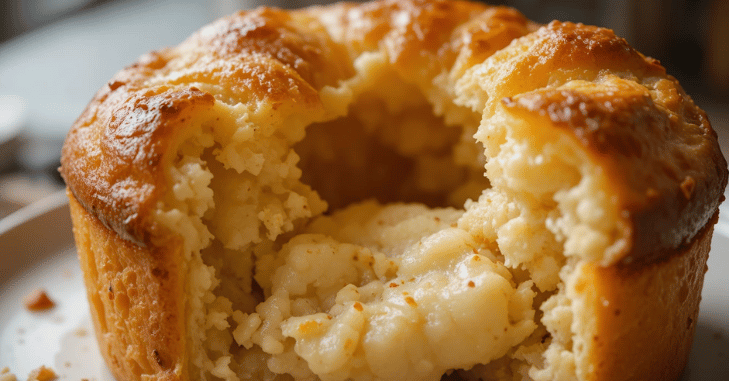
Plain flour, not self-raising
Yorkshire puddings rise on steam, and steam alone. Chemical raising agents create small bubbles throughout the batter, and those bubbles work against the single large cavity you are trying to form. The result is a cakey, close-textured pudding that domes rather than hollows. If self-raising flour is all you have in the cupboard, the puddings will still be edible, but they will not look like the ones you are picturing.
Which fat to use
Beef dripping is the traditional choice and gives the best flavour by a distance, particularly alongside beef. Lard is a close second. Sunflower, rapeseed or vegetable oil all work perfectly well and have the high smoke points the method demands. Olive oil does not – it starts smoking and breaking down below the temperature you need, and it tastes wrong. Do not use butter either; the milk solids burn long before the tin is hot enough.
Method
- Crack the eggs into a measuring jug and note the volume. Whisk them lightly with the salt.
- Measure the same volume of plain flour into a bowl. Make a well in the centre, pour in the beaten egg, and whisk from the middle outwards until you have a thick, smooth paste. Bringing the flour in gradually is what stops lumps forming – if you tip everything in at once you will be chasing lumps for five minutes.
- Whisk in the same volume of milk, a third at a time, until the batter is smooth and about the consistency of single cream. Pour it back into the jug.
- Cover and rest for at least 30 minutes at room temperature, or up to 24 hours in the fridge. If it has been in the fridge, let it come back to room temperature before using.
- Heat the oven to 220C fan / 240C conventional / gas mark 9. Put a teaspoon of dripping or oil into each hole of a 12-hole tin (a tablespoon per hole for a 4-hole tin) and slide it onto the top shelf for 10-12 minutes, until the fat is shimmering and faintly smoking.
- Give the rested batter a quick whisk. Pull the shelf out – do not take the tin to the worktop – and pour batter into each hole until it is about two-thirds full, working quickly. It should hiss and spit the moment it lands. If it does not, your fat is not hot enough.
- Push the shelf back and shut the door. Bake for 20-25 minutes for small puddings, 25-30 for large ones, without opening the door for at least the first 20 minutes.
- They are done when they are deeply golden brown, dry and firm to a light tap, and noticeably taller than the tin. Pale golden is not done. Serve within a few minutes.
Why you must not open the oven door
A Yorkshire pudding rising is a balloon of steam held up by a soft, wet protein wall that has not yet set. Opening the door drops the oven temperature by 20-30C in a couple of seconds and lets a rush of cool air onto that wall. The steam inside condenses, the pressure holding the pudding up disappears, and the structure folds before it has firmed. That is the entire mechanism behind the classic sunken pudding, and it is why the rule sounds so unreasonably strict.
After about 20 minutes the walls have set and dried enough to hold their own shape. At that point you can open the door briefly to check colour or rotate the tin. Before then, use the oven light.
Scaling the batter
Because the method is a ratio rather than a fixed recipe, it scales cleanly. Use this as a starting point and always let the volume of the cracked eggs be the master measurement.
| Serving | Eggs | Plain flour | Milk | Tin | Bake |
|---|---|---|---|---|---|
| Yorkshires for 2 | 2 medium (about 100ml) | 100ml, about 58g | 100ml | 6 holes of a 12-hole tin | 18-22 minutes |
| Yorkshires for 4 | 3 medium (about 150ml) | 150ml, about 85g | 150ml | 9-10 holes | 20-24 minutes |
| Standard batch of 12 | 4 medium (about 200ml) | 200ml, about 115g | 200ml | Full 12-hole tin | 20-25 minutes |
| 4 large puddings | 4 medium (about 200ml) | 200ml, about 115g | 200ml | 4-hole Yorkshire tin | 25-30 minutes |
| Toad in the hole for 4 | 4 medium (about 200ml) | 200ml, about 115g | 200ml | Roasting dish about 30 x 20cm | 30-35 minutes at 200C fan |
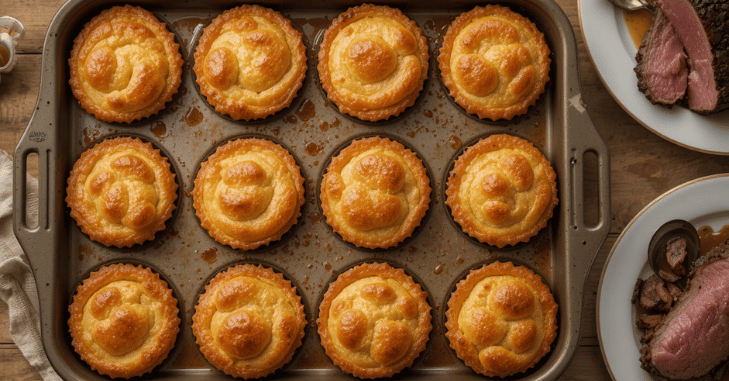
Tin choice changes the pudding more than you would think
- 12-hole bun or patty tin (shallow, sloping sides): crisp, wide, slightly flatter puddings with a big surface area. Good for gravy-soaking.
- 12-hole deep muffin tin (straight sides): the tall, dramatic, steep-sided puddings people photograph. The straight walls give the batter something to climb.
- 4-hole Yorkshire tin: proper large puddings, the sort you fill with beef and gravy as a main course.
- Avoid silicone. It does not conduct heat quickly enough, so the fat never gets properly hot and the base never crisps.
- Older, darker tins outperform shiny new ones, because dark metal absorbs radiant heat faster. A well-used non-stick bun tin is a genuine asset.
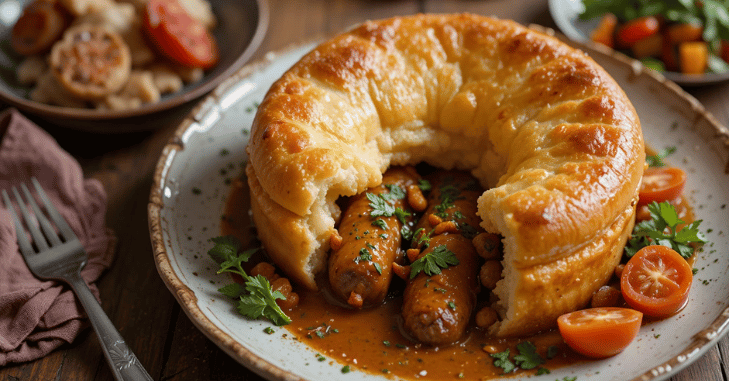
Toad in the hole with the same batter
The batter is identical; only the vessel and the temperature change. Brown 8 good pork sausages in a roasting dish with 2 tablespoons of dripping at 220C fan for about 10 minutes, turning once. Pull the dish out, pour the rested batter around the sausages in one steady stream, and return it immediately. Drop the oven to 200C fan / 220C conventional / gas mark 7 and bake for 30-35 minutes until the batter is risen, deep brown and set in the middle.
The two most common mistakes are a dish that is too large – the batter spreads thin and never climbs – and adding onion gravy or vegetables to the dish, which releases moisture and stops the batter setting. Cook the gravy separately.
Troubleshooting
| What happened | Why | What to do next time |
|---|---|---|
| They barely rose at all | Fat was not hot enough, or the oven was under temperature. | Preheat the tin with the fat for a full 10-12 minutes and listen for the sizzle when the batter hits. Check your oven with a thermometer – many run 10-20C cool. |
| They rose then collapsed | Underbaked, or the door was opened too early. | Bake until deep golden and firm, not pale. Leave the door shut for the first 20 minutes. |
| Soggy, greasy bottoms | Too much batter in each hole, or too much fat. | Fill to two-thirds and use a teaspoon of fat per hole, no more. |
| Dense and doughy inside | Batter too thick, or self-raising flour. | It should pour like single cream. Use plain flour and add a splash more milk if it is claggy. |
| Stuck fast to the tin | Not enough fat, or worn non-stick. | Make sure the fat coats the sides, not just the base, and retire tins whose coating has gone. |
| Some rose, some did not | Fan oven hot spots, or the tin was filled too slowly and the fat cooled. | Fill fast, and rotate the tin once at the 20-minute mark. |
| Lumpy batter | Milk added all at once to dry flour. | Make a thick paste with the egg first, then let the milk down gradually. |
Make ahead, reheating and freezing
- Batter: keeps covered in the fridge for up to 24 hours and arguably improves – the starch hydrates fully and the gluten relaxes. Bring it back to room temperature and whisk before pouring.
- Cooked puddings: cool completely on a rack, never in a sealed container, or the steam inside turns them leathery.
- Freezing: open-freeze on a tray, then bag. They keep for a month.
- Reheating from frozen: straight onto a hot baking tray at 220C fan for 4-5 minutes. They come back genuinely crisp, which is more than can be said for most reheated baking.
- Timing the roast: Yorkshires need the oven hotter than a resting joint does, which is why they go in while the meat rests. Twenty-five minutes of resting for the beef is exactly the window you need.
Serving, and what else to put on the plate
Traditionally in Yorkshire the puddings came first, served alone with onion gravy before the meat, as a way of filling people up cheaply. It is still a very good way to eat them, and it takes the pressure off getting everything to land on the table at the same moment.
Beyond the beef and gravy default, they take well to leftovers piled inside, and large ones make a decent container for stew. Serve them with a soft, buttery vegetable side to balance the crispness – cheesy leeks do that job better than most. If you fancy a change from the British roast entirely, a sealed-parcel lamb kleftiko uses the same lazy-Sunday oven slot with far less last-minute work.
For pudding afterwards, the same warm, unfussy register applies: apple crumble or bread and butter pudding can both go into the falling oven while everyone eats.
A note on the ratio
The equal-volume idea is strongly associated with Mary Berry, and it is characteristic of her whole approach to teaching baking: replace a number you have to remember with a rule you can reason about. This recipe is written from scratch in my own words and my own measurements, but the principle it is built on – equal egg, flour and milk, rested batter, smoking fat, closed door – is hers, and it is the reason so many British home cooks can make Yorkshire puddings without a recipe at all.
While the batter can be prepared and rested in advance, Yorkshire puddings are best baked fresh for maximum rise and crispiness.
No, plain flour is essential. Self-raising flour can interfere with the structure and texture, leading to uneven rise.
Beef dripping is traditional, but vegetable oil or sunflower oil works well for a lighter flavour. The key is very hot fat.
Partially cook sausages in a tin, then pour over the rested batter and bake at a high temperature until golden and risen.

