There are no files to download on this page, and it would be dishonest to pretend otherwise. Frog colouring sheets are one of the most freely available things on the internet — every major UK education supplier, museum and wildlife charity gives them away, and you can print a decent one in about ninety seconds. What is genuinely hard to find is everything around the sheet: which British frog you are actually looking at, what colour it really is, what to do with the finished picture, and which paper stops felt tips bleeding through.
So this is the useful half. Below: the four UK amphibians worth colouring accurately and how to tell them apart, the frog life cycle with real British timings, printer settings that stop you wasting a cartridge, paper and pen recommendations with rough prices, and a bank of EYFS and Key Stage 1 activities that turn twenty minutes of colouring into a science lesson.
Where to find good free sheets (and what makes one good)
Search using the American spelling as well as the British one. Almost all of the printable stock online is filed under frog coloring pages rather than colouring, so searching only the British spelling halves what you see. Once you have results, the difference between a sheet worth printing and one that wastes paper is visible in about two seconds.
- Look at the line weight. Thick, closed outlines for under-fives. Thin lines with lots of internal detail are frustrating for small hands and end up scribbled over.
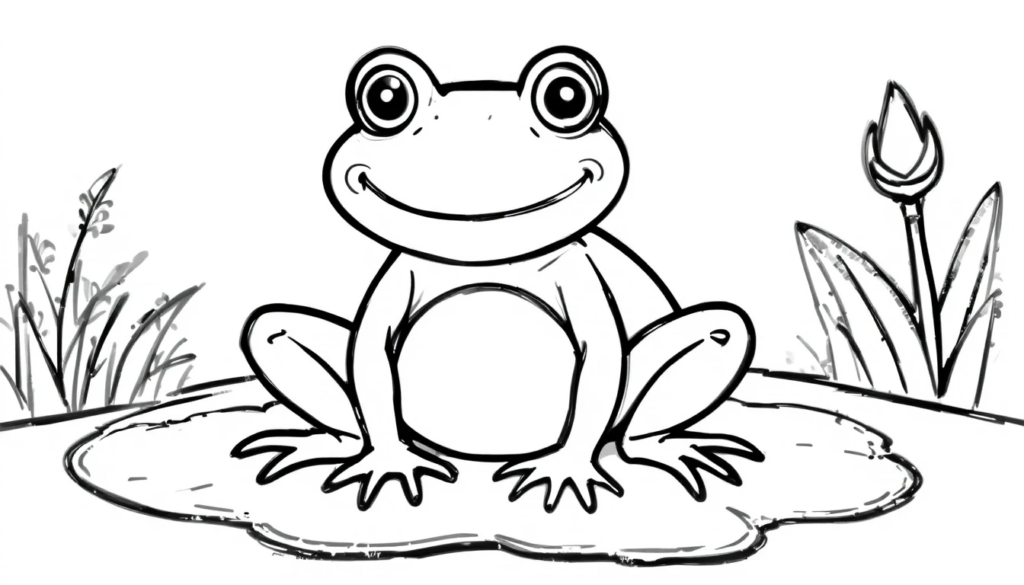
- Check the frog is a frog. A great many sheets are cartoon tree frogs with suckered toes and enormous eyes. Fine for fun, useless if you want children to recognise what is in the pond.
- Prefer sheets with a life-cycle version. Six-stage wheels and sequence strips are far more use in a classroom than a single frog on a lily pad.
- Avoid heavy black fills. Large solid areas drink ink and leave nothing for the child to do.
- Check the margins. A drawing that runs to the edge of the page will be cropped by most printers.
- Good sources to try: UK wildlife charities and nature reserves, museum learning pages, county wildlife trust education sections, and the free areas of the big teacher resource sites. Between them they cover realistic species drawings, life cycles and pond habitat scenes without anyone needing to pay.
The British frogs and toads worth colouring accurately
Britain has a short amphibian list, which is good news — a child can learn to identify all of them. The common frog is what is in nearly every garden pond. The rest are worth knowing because they look different in ways children find genuinely interesting.
| Species | How to tell it apart | Colours to use | Where it lives in the UK |
|---|---|---|---|
| Common frog (Rana temporaria) | Smooth, moist skin; long back legs; hops in leaps; dark patch behind the eye | Olive to yellow-brown, occasionally reddish; irregular dark blotches; dark bars across the back legs; cream belly | Ponds, gardens and damp grassland across almost all of Britain and Ireland |
| Common toad (Bufo bufo) | Dry, warty skin; shorter legs; crawls rather than hops; coppery-orange eyes | Drab brown to olive, no bright markings; paler, sometimes mottled belly | Gardens, woodland and drier ground; returns to ponds only to breed |
| Natterjack toad (Epidalea calamita) | A bright yellow stripe straight down the middle of the back; runs rather than hops | Olive-brown with a lemon-yellow dorsal stripe and greenish-yellow eyes | Very rare: coastal sand dunes and sandy heaths in parts of Merseyside, Cumbria, the Solway and Norfolk |
| Pool frog (Pelophylax lessonae) | Pale stripe down the back; sits at the pond edge; noisy call | Brown-green with a pale dorsal stripe | Reintroduced at a very small number of Norfolk sites only |
| Great crested newt (Triturus cristatus) | Not a frog at all — warty near-black skin; males grow a jagged crest in spring | Almost black above, vivid orange with black spots underneath | Ponds across England and Wales; strictly protected |
The single most common colouring error is making every frog bright grass green. British common frogs are usually brownish or olive, and a child who colours one accurately and then finds a real one in the garden has learned something a green cartoon frog would never have taught them.
Getting a common frog right, feature by feature
- Base coat: olive or yellow-brown, applied lightly. Some individuals are almost brick red, so there is a legitimate range to choose from.
- The eye patch: a dark brown patch behind and just below the eye, covering the eardrum. This is the identification feature. Get this and the frog is recognisable even if everything else is rough.
- Blotches: irregular dark brown marks scattered over the back — not spots in a neat pattern.
- Leg bars: dark stripes running across the back legs, like faint tiger stripes.
- Two ridges: a pale raised fold running down each side of the back from behind the eye. Suggest with a slightly lighter line.
- The belly: cream or pale yellow, sometimes lightly mottled.
- The eye: a golden-bronze iris with a horizontal pupil. A toad’s is coppery orange, which is the fastest way to tell a colouring of one from the other.
- Texture: frog skin is smooth and wet-looking. Leave a small white highlight rather than drawing bumps. Bumps belong on the toad.
The life cycle, with real British timings
Metamorphosis is the reason frogs are on the primary curriculum at all, and it is the rare science topic where a child can watch the whole thing happen locally in a single spring. Timings vary a lot with the weather and how far north you are, so treat these as typical rather than fixed.
| Stage | Typical UK timing | What it looks like | Colour it |
|---|---|---|---|
| Spawn | Late January to March; sometimes December in the far south-west, April in northern Scotland | Floating clumps of clear jelly, each blob with a black dot inside | Clear jelly with black centres; a wash of pale grey works better than leaving it white |
| Newly hatched tadpole | Roughly two to three weeks after spawning | Tiny and almost black, clinging to pond weed; feathery external gills at first | Near-black with a hint of brown |
| Tadpole with back legs | Around six to nine weeks | Body browner and gold-speckled; back legs appear first | Dark brown with gold or bronze speckling |
| Tadpole with four legs | Around nine to twelve weeks | Front legs emerge; the tail begins to shorten; lungs replace gills | Brown-green, with the tail fading |
| Froglet | Around twelve to sixteen weeks, so often June or July | A frog the size of a thumbnail, sometimes with a stub of tail | Olive brown, already with the dark eye patch |
| Adult frog | Two to three years before it breeds | Full-sized, with the blotches and leg bars developed | The full common frog palette |
One detail children love and adults usually get wrong: frogs lay spawn in clumps, toads lay it in long strings wound around pond plants. If a colouring sheet shows a toad next to a jelly clump, it is drawn wrong, and pointing that out to a Year 2 class is a better observation lesson than any worksheet.
Frog facts children genuinely ask about
- They drink through their skin. A frog never takes a sip of water — it absorbs it, mostly through a patch on its belly and thighs, which is why they must stay damp.
- They breathe through their skin too, especially underwater and while overwintering at the bottom of a pond.
- Tadpoles start out largely vegetarian, grazing algae, and become carnivorous later — which is why they will eat each other in a crowded tank.
- A frog’s eyes help it swallow. It pulls them down into its head to push food down its throat.
- Frogs shed their skin regularly and usually eat it.
- The common frog can change tone over hours to blend with its surroundings — not chameleon-fast, but noticeably.
- Toads have poison glands behind the eyes, which is why dogs that mouth one foam and drop it. Frogs do not have this to anything like the same degree.
- Only a fraction of the spawn in a pond ever becomes an adult frog. Most is eaten. That is not a sad fact to hide from children; it explains why a female lays so much.
- Frogs are amphibians, which means two lives — one in water with gills, one on land with lungs. That word is worth teaching explicitly.
Does colouring actually help fine motor skills?
Yes, but with limits, and the limits matter more than the claim. Staying inside a line is a real precision task: it needs a stable shoulder, a controlled wrist, and the small hand muscles working independently of the arm. Sustained colouring also builds the endurance that handwriting later demands — a child who tires after two minutes of colouring will tire after two lines of writing.
What colouring does not do is teach a pencil grip on its own, and it is not the strongest fine motor activity available. Threading beads, using tweezers or tongs, snipping with scissors, pegging washing on a line and squeezing playdough all build hand strength faster. Use colouring as one item in that mix, not the whole diet. Past roughly age seven, colouring stops developing new motor skill and simply becomes an enjoyable thing to do, which is a perfectly good reason to keep doing it.
- Ages 1-3: whole-arm scribbling with chunky crayons. Do not correct where the marks land. Large, simple shapes only.
- Ages 3-4: beginning to aim for an area. Thick outlines, few regions, triangular pencils to encourage a tripod grip.
- Ages 4-5: mostly inside the lines on large shapes. This is where sustained effort matters more than accuracy.
- Ages 5-7: smaller regions, outlining before filling, choosing colours for a reason. Introduce fineliners for outlining.
- Ages 7+: shading, blending and accuracy against a photograph. Now it is an art skill, not a motor one.

Printer settings that stop you wasting ink
- Print in greyscale or black and white. A line drawing has no colour in it; leaving the printer on colour still pulls from the colour cartridges to build a richer black.
- Use draft or economy quality. You need a legible outline, not photographic black. This can roughly halve ink use on a line drawing.
- Set scaling to fit to printable area. Many free sheets are US Letter, which is slightly wider and shorter than A4 — printed at 100 per cent, the edges get clipped.
- Print one test copy before a class set. Always. Cropped feet on thirty sheets is a common staffroom story.
- For a class set, print one master and photocopy it. Per-sheet cost on a school copier is a fraction of inkjet, and the copier handles heavier paper better.
- One sheet per child under five, two-up only for older children. A5 regions are too small for a four-year-old to succeed at.
- If you print heavily at home, per-page cost is dominated by the cartridge, not the paper — refillable tank printers and continuous ink supply systems change that maths considerably if colouring sheets are a weekly habit.
Paper and pens: what to buy and roughly what it costs
Prices below are typical UK retail as of 2026 and move around with pack size and supplier — treat them as a guide rather than a quote. School buyers will usually do better through education suppliers such as Hope Education, GLS Educational, YPO or Baker Ross than through a high street stationer; parents will find the same brands in Ryman, The Works and the larger supermarkets.
| What to buy | Typical UK price | Best for | Why it matters |
|---|---|---|---|
| Plain white 80gsm A4 copier paper, ream of 500 | Around £5 to £8 | Everyday pencil colouring | Perfectly fine for pencils and crayons; felt tips will bleed through it |
| 100-120gsm white paper, 250 sheets | Around £8 to £14 | Felt tips and fineliners | Stops bleed-through and stops the sheet buckling |
| 160gsm white card A4, 50-100 sheets | Around £6 to £12 | Work going on display or being cut out | Survives handling, glue and a split pin for a life-cycle wheel |
| Staedtler Noris Club colouring pencils, pack of 12 | Around £3 to £5; classpacks of 144 or 288 from school suppliers | Ages 4 and up, everyday use | Soft, strongly bonded lead that breaks far less than budget pencils |
| Faber-Castell Jumbo Grip or similar chunky triangular pencils, 12 | Around £6 to £12 | Ages 2 to 4 | The triangular barrel physically encourages a tripod grip |
| Berol Colourfine fineliners, pack of 12 | Around £5 to £9 | Ages 6 and up, outlining and detail | Water-based and washable, with a tip fine enough for leg bars and eye patches |
| Washable chunky felt tips (Crayola Ultra-Clean or equivalent), 12 | Around £4 to £8 | Ages 3 to 6 | They wash out of school uniform, which is the only spec that matters to parents |
| Chunky wax crayons or crayon blocks | Around £3 to £6 | Under-threes | Survive heavy pressure and work for bark and leaf rubbings on the same trip |
One purchase that pays for itself in a classroom: a decent hand-crank sharpener at roughly £10 to £25. Blunt pencils are the single biggest cause of a colouring session collapsing, and thirty children queueing at a broken sharpener will eat the twenty minutes you set aside.
EYFS and Key Stage 1 activities that pair with a colouring sheet
| Activity | Stage | Time | What you need | What it teaches |
|---|---|---|---|---|
| Life-cycle wheel with a split pin | Reception to Year 2 | 25 min | Two card circles, split pin, pencils | Metamorphosis as a repeating cycle, not a straight line |
| Cut and sequence the six stages | Nursery to Year 1 | 15 min | Six coloured pictures, scissors, glue | Sequencing, ordinal language, scissor control |
| Colour-match against a real photograph | Year 1 to Year 3 | 20 min | A photo of a common frog, pencils | Close observation and honest colour choice |
| Frog or toad? Sorting hoops | Reception to Year 2 | 15 min | Coloured pictures of both, two hoops | Classification by observable features |
| Camouflage challenge: colour it so it hides | Year 2 to Year 4 | 25 min | Outline plus a printed pond-edge background | Adaptation and survival |
| Collaborative pond habitat mural | Nursery to Year 2 | 40 min | Large backing paper, everyone’s frogs cut out | Habitat, and every child sees their work displayed |
| Count and colour the spawn dots | Nursery to Reception | 10 min | A spawn clump outline | One-to-one correspondence and early counting |
| Label the life cycle with the real words | Year 1 to Year 3 | 15 min | Word cards: spawn, tadpole, gills, lungs, froglet, metamorphosis | Scientific vocabulary used precisely |
| Colour while listening to a frog story | Nursery to Year 1 | 20 min | Any pond-life picture book | Listening stamina; it pairs well with the independent half of a guided reading rotation |

A 40-minute frog life-cycle lesson you can run tomorrow
- 0-5 min: show a photograph of frogspawn and ask what they think is inside. Take wrong answers seriously; the point is curiosity, not the right answer.
- 5-12 min: teach the six stages in order with the real vocabulary on the board. Say each word, have them say it back, then have one child put the six pictures in order at the front.
- 12-15 min: the two facts that stick — tadpoles breathe with gills and frogs with lungs, and frogs lay clumps while toads lay strings.
- 15-32 min: colour the life-cycle wheel. Circulate and ask individuals which stage they are on and what happens next, rather than commenting on neatness.
- 32-37 min: assemble with split pins and turn the wheel through a full cycle, saying the stages aloud.
- 37-40 min: one question to finish: why does a frog lay so many eggs? Steer them towards the answer that most are eaten.
Ponds, spawn and the law: what to tell children
If a colouring session leads to a pond visit — and it should — there are UK rules worth knowing, because two of the species above are strictly protected.
- The natterjack toad and great crested newt are fully protected under the Wildlife and Countryside Act 1981 and the habitats regulations. It is an offence to capture, handle, disturb or damage the habitat of either without a licence. Look, do not touch, and do not go pond-dipping where either is known to be present.
- The common frog and common toad have partial protection, chiefly against sale and trade. You are not committing an offence by watching them in your garden.
- Do not move spawn between ponds. It is the main way ranavirus and invasive pond plants spread, and it does far more harm than the good intended.
- If you do raise spawn in a classroom tank, take water from the same pond, keep the tank cool and out of direct sun, feed with boiled lettuce or specialist food once they are grazing, and return the froglets to the same pond they came from.
- Wash hands before and after any contact with pond water, and never use hand cream or sanitiser beforehand — amphibians absorb through their skin.
- The best option is usually to watch and not take anything. A weekly visit to the same pond from February to July shows children the whole life cycle in situ, which no tank ever quite matches.
Mistakes to avoid
- Colouring every frog bright green. That is a tropical tree frog, not a British one.
- Giving a toad smooth green skin, or a frog warts.
- Drawing a frog beside a string of spawn — strings are toads, clumps are frogs.
- Printing on 80gsm and then handing out felt tips. It bleeds onto the table and through to the next sheet.
- Correcting a three-year-old for going outside the lines. At that age the marks are supposed to be everywhere.
- Treating colouring as handwriting preparation on its own. It is one part of a much wider set of hand-strength activities.
- Choosing a sheet with dozens of tiny regions for a Reception class. Nobody finishes, and unfinished work discourages.
- Bringing spawn indoors with no plan for returning the froglets.
The sheet itself is the least important part of any of this. What a child remembers a year later is that the frog in the garden is brown rather than green, that it has a dark patch behind its eye, and that the jelly in the pond in February turns into it. Print whatever outline you like — the teaching is what you say while they colour. If you are an early years practitioner looking to build this kind of subject knowledge more formally, accredited early years and teaching assistant development routes cover the science and child development behind it properly.

Natural shades like green, brown, and yellow work best. These colors teach students about realistic coloring while also encouraging attention to detail in their artwork.
creative choices like blue, purple, or unusual shades inspire imagination and help children explore color combinations, patterns, and artistic freedom beyond realistic depictions.
Using light and dark tones adds depth and dimension. Shading develops observation, fine motor skills, and understanding of light, shadow, and visual effects in their drawings.
They enhance concentration, planning, memory, and problem-solving abilities. Working on patterns, shapes, and colors develops critical thinking while combining learning with creativity.
both formats are available. Digital pages allow tablet coloring, while printouts provide hands-on practice, giving flexibility for home or classroom learning.