In today’s world, environmental responsibility is no longer simply a fashionable trend—it has become a necessity. Every day, humanity consumes enormous amounts of resources, while the volume of plastic waste continues to grow. One source of this waste is office and home printing equipment, particularly disposable inkjet printer cartridges. Many users do not realize that every cartridge replacement means another plastic product that often ends up in a landfill after use.
For this reason, a continuous ink supply system (CISS) is now considered not only a way to achieve substantial savings on printing but also a technology that makes everyday printing more environmentally friendly. It can significantly reduce plastic waste, improve resource efficiency, and support sustainability principles without compromising print quality. You might also like Why fire sprinkler system reliability depends on routine servicing.
The Problem with Disposable Cartridges
Most inkjet printers traditionally use cartridges that must be replaced once the ink runs out. Although many manufacturers promote cartridge recycling programs, in practice, a large proportion of used cartridges are never returned to specialized collection centers and eventually become household waste.
Each cartridge consists of several types of plastic, metal components, seals, an electronic chip, and residual ink. Because of this complex structure, recycling requires sorting, cleaning, and separating the materials, making the process expensive and not always economically practical.
As a result, large numbers of used cartridges accumulate in landfills for years, where the plastic can take decades or even centuries to decompose.
When you consider that a single office may use dozens or even hundreds of cartridges per year, the scale of the problem becomes clear.
How Does a CISS Change the Situation?
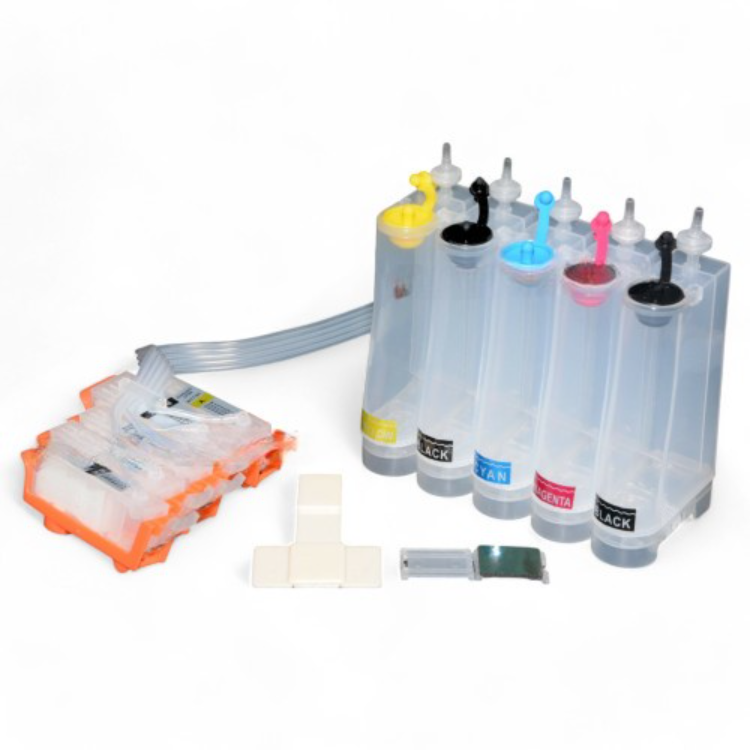
A continuous ink supply system operates according to a different principle. Instead of regularly replacing cartridges, users rely on reusable ink tanks that are refilled as the ink is consumed.
This means that a single system can be used for many years without the need to replace plastic components constantly.
In practice, the user purchases a CISS kit once and then simply adds ink to the dedicated tanks whenever necessary.
As a result, the number of plastic products that must be manufactured, transported, and disposed of is significantly reduced.
Reusable Ink Tanks
One of the main environmental advantages of a CISS is the repeated use of its key components.
Ink tanks are made from durable polymers designed for long-term operation. When used correctly, they can remain functional for years without losing their airtightness or performance.
Unlike cartridges, which often become waste after a single cycle of use, CISS tanks continue performing their function for an extended period.
This approach corresponds with the modern concept of a circular economy, whose main principle is to keep products in use for as long as possible while minimizing waste generation.
Less Manufacturing Means Lower Resource Consumption
Every new cartridge requires raw materials, manufacturing capacity, energy, and transportation.
The production of a cartridge requires:
- plastic;
- electronic components;
- metals;
- packaging materials;
- energy resources.
When users switch to a CISS, the need to manufacture large numbers of new cartridges is significantly reduced.
This results in:
- lower consumption of petroleum-based materials used to produce plastic;
- reduced electricity consumption;
- fewer industrial emissions;
- less transportation.
Although the contribution of a single user may appear insignificant, the overall effect becomes substantial when multiplied across thousands of companies and millions of printer owners.

Reducing the Carbon Footprint
The environmental impact of a product is determined not only by the amount of waste it produces but also by the greenhouse gas emissions generated during manufacturing, packaging, transportation, and disposal.
Disposable cartridges go through a complete production cycle every time the ink runs out. They must be manufactured, packaged, transported to retailers, and then collected, recycled, disposed of, or replaced with new cartridges.
A CISS eliminates the need for many of these processes. Instead, the user periodically purchases compact bottles of ink, which require significantly fewer materials and less energy to produce.
As a result, the overall carbon footprint associated with operating printing equipment is reduced.
More Efficient Use of Ink
Another environmental advantage of a CISS is the more efficient use of ink.
Standard cartridges often contain a certain amount of residual ink when they stop working, and this remaining ink cannot always be used completely. Consequently, unused consumable material is discarded together with the cartridge. Also worth reading: Build a Lean Marketing System That Keeps Working.
A continuous ink supply system delivers ink steadily to the printhead, allowing users to make maximum use of the available volume.
This approach helps to:
- minimize ink loss;
- reduce waste;
- use resources more efficiently.
You can see these benefits for yourself by ordering a PRINTOUT system: https://printout24.com/
Less Packaging Means Less Waste
Each cartridge is sold in its own individual packaging.
It usually consists of:
- cardboard;
- plastic;
- polyethylene bags;
- protective components.
When cartridges are replaced regularly, users accumulate a considerable amount of packaging waste.
With a CISS, users only need to purchase bottles of ink, which come in much more compact packaging.
This helps reduce household waste and makes more efficient use of packaging materials.
Corporate Environmental Responsibility
An increasing number of companies are adopting ESG principles—Environmental, Social, and Governance—and implementing sustainability strategies. One practical step in this direction is optimizing the use of office equipment.
Switching to a CISS helps businesses:
- reduce the use of disposable consumables;
- lower spending on cartridge purchases;
- decrease the amount of generated waste;
- support corporate environmental initiatives;
- strengthen the company’s image as a responsible employer.
For large organizations, even a relatively small reduction in cartridge use can prevent dozens or hundreds of kilograms of plastic from reaching landfills each year.
The Contribution of Educational Institutions to Environmental Protection
Schools, colleges, and universities also work with large volumes of printed materials.
Using a CISS in education not only helps save budget funds but also encourages a culture of responsible consumption among pupils and students.
When an educational institution demonstrates the practical use of environmentally responsible solutions, it sets a positive example for younger generations and promotes the principles of sustainable development.
A High-Quality CISS Also Offers Long-Term Durability
The environmental benefits of any technology largely depend on its quality.
Modern continuous ink supply systems are made from durable polymers that are resistant to ink exposure and temperature fluctuations.
High-quality kits are equipped with:
- reusable ink tanks;
- durable tubing;
- auto-reset chips;
- airtight cartridges;
- materials that do not react chemically with ink.
A longer service life means less waste and more efficient use of resources.
Environmental Benefits Combined with Financial Savings
One of the most important advantages of a CISS is that environmental responsibility and cost savings do not conflict with one another.
Users receive several benefits at the same time:
- significantly lower printing costs;
- reduced plastic waste;
- repeated use of the system’s main components;
- lower consumption of natural resources;
- a longer service life for printing equipment when high-quality ink is used and the system is operated correctly.
This approach is often referred to as eco-efficiency, where responsible environmental practices also help optimize costs.