


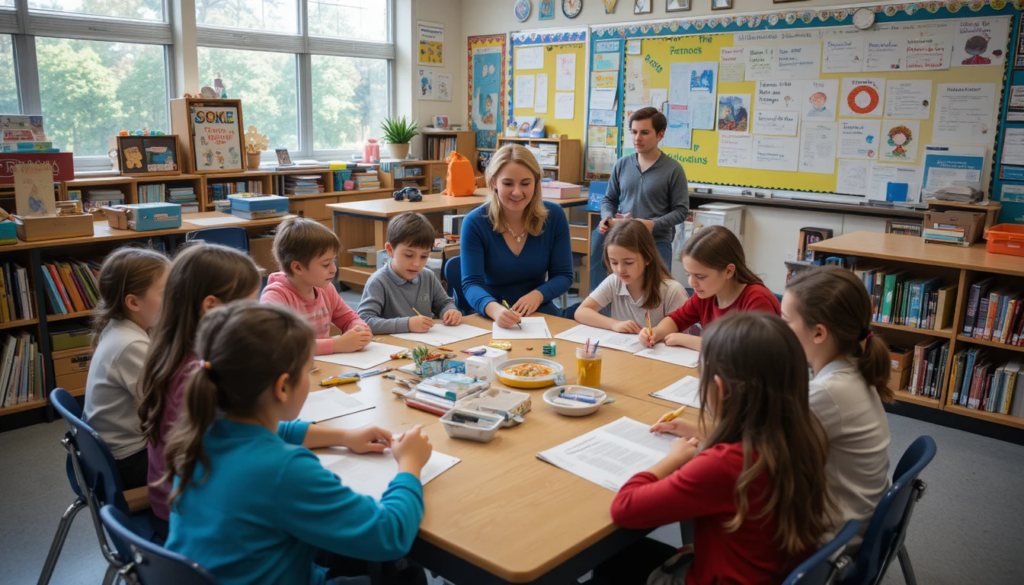
A guided reading activity is a short piece of work you do with a small group — usually four to six children — on a text they can nearly, but not quite, read independently. The point is not to get through the book. The point is that the group is close enough for you to hear every child read, catch the specific error each one is making, and teach into it on the spot. That is the one thing whole-class reading cannot do.
What follows is the practical version for UK primary teachers and teaching assistants: where guided reading sits against the national curriculum and the phonics expectations, an honest account of the guided versus whole-class argument that most schools have had at some point, banks of activities by year group with timings and the resources you actually need, VIPERS question stems, a two-minute record-keeping format, and a five-day rotation that works when you have one adult and thirty children.
Where guided reading sits against the national curriculum
The national curriculum splits reading into two strands: word reading and comprehension. In Key Stage 1 the programmes of study are explicit that word reading depends on systematic synthetic phonics taught to fluency, and comprehension develops through discussion of texts that are well above the level children can decode for themselves. Those two strands need different teaching, and that distinction is the whole design brief for a guided session.
In practice it means a Reception or Year 1 guided group is mostly a word reading session: decoding, blending, and rereading for fluency using a book matched to the phonics the child has been taught. By Year 4 the same twenty minutes is almost entirely comprehension, on a text the child can decode without effort. Running a Year 1 group as though it were a Year 5 group — asking for inference from children who are still sounding out — is the most common way guided reading stops working. The Year 1 phonics screening check in June, forty words including pseudo-words, is a useful marker of where a child sits on that journey.
| Stage | Where the child is | What the guided session is mainly for | Text you use |
|---|---|---|---|
| Reception | Learning grapheme-phoneme correspondences, blending sound by sound | Automatic blending, tricky words, oral comprehension | Fully decodable, matched to the phonics taught so far |
| Year 1 | Decoding accurately but slowly, often word by word | Blending speed, rereading for fluency, simple retrieval | Decodable, reread two or three times |
| Year 2 | Mostly accurate; fluency and expression are the gap | Prosody, punctuation, first inference work | Short real books; decodables only for children off-track |
| Years 3 and 4 | Fluent enough that comprehension is the limiter | Vocabulary in context, inference, sequencing and structure | Rich texts slightly above independent level |
| Years 5 and 6 | Reading to learn; unfamiliar vocabulary is the main barrier | Summarising, author intent, comparing texts | Challenging extracts, non-fiction as well as fiction |
| Any year, off-track readers | Gaps in phonic knowledge that will not close by osmosis | Keep-up phonics on the specific gap, then fluency | Matched decodable text, age-neutral in appearance |

The guided versus whole-class reading argument, honestly
For most of the 2000s guided reading was the default in English primary schools: a carousel where one group read with the teacher and the other five did activities that were, if everyone is honest, mostly there to keep them quiet. Since about 2018 a great many schools have swung to whole-class reading — everybody on the same rich text, taught together — and the DfE’s reading framework, updated in July 2023, pushed the profession further towards matched decodable texts and explicit phonics in the early stages rather than open-ended guided sessions on books children cannot yet read.
Neither camp is entirely right, and the schools that get the best of it treat the two as different tools rather than rival ideologies. The real objection to old-style guided reading was never the small group. It was the carousel around it: five sixths of the class doing low-value tasks so that one sixth could have twenty good minutes. If you can solve the independent work problem, the small group is extremely powerful. If you cannot, whole-class reading is genuinely better than a bad carousel.
- Small-group guided reading wins when children are still decoding, when you need to hear individuals read aloud, when the gap between the strongest and weakest reader in the class is very wide, and for keep-up sessions after a phonics assessment.
- Whole-class reading wins when decoding is secure, when the barrier is vocabulary and background knowledge, when you want every child to meet an ambitious text rather than a levelled one, and when adult time is scarce.
- Both fail when the text is unmatched to the reader, when the adult talks for more than half the session, and when nobody records what the individual child actually got wrong.
The workable position in most schools is: whole-class reading as the main comprehension diet from around Year 2 or 3 upwards, plus daily small-group guided or keep-up sessions for the children who are off-track, plus small-group work in Reception and Year 1 where reading aloud to an adult is non-negotiable.
What a 20-minute guided session actually contains
The structure below works from Year 1 to Year 6; only the balance shifts. Keep the whole thing to twenty minutes and keep your own talking to under a third of it.
- Book introduction and pre-teach (2-3 minutes). Say what the text is and pre-teach two or three words that would otherwise stop children dead. Do not summarise the plot for them.
- Set the purpose (30 seconds). One sentence: today we are working out how the character feels from what he does. Children should be able to repeat it back.
- Independent reading with individual listening (6-8 minutes). Everyone reads the same section quietly at their own pace while you lean in to one child at a time for about a minute each. This is the part people cut, and it is the part that justifies the group existing.
- Teach into the errors you just heard (3-4 minutes). Not a general lesson — the specific thing three of them did wrong. A grapheme confusion, ignoring commas, skipping the word they did not know.
- Questioning and discussion (4-5 minutes). Two or three good questions, not ten shallow ones. Insist on evidence: which words made you say that?
- Close and next step (1 minute). Note what each child needs next while they are still in front of you, not at four o’clock.

Six children is the practical maximum. At seven you stop hearing everyone; at three you are wasting adult time that another group needs.
VIPERS: what it is and how to use it without it becoming a worksheet
VIPERS is a mnemonic developed by Rob Smith of the Literacy Shed and adopted very widely in English primary schools, because it maps neatly onto the content domains that the Key Stage 1 and Key Stage 2 reading tests assess. It stands for Vocabulary, Inference, Prediction, Explanation, Retrieval and — in Key Stage 1 — Sequencing, which becomes Summarising in Key Stage 2. It is a planning checklist, not a lesson format: its job is to stop you asking retrieval questions for three weeks running without noticing.
| Strand | What the child has to do | A stem you can use tomorrow |
|---|---|---|
| Vocabulary | Work out and use the author’s word choices | What does the word trudged tell you about how she was walking? Find and copy a word that means almost the same as furious. |
| Inference | Draw a conclusion the text does not state, and justify it | How do you know he was lying? Which words made you think that? Find the sentence that gives it away. |
| Prediction | Use what has happened so far to say what might happen next | What do you think will happen when she opens the door, and which part of the page makes you say so? |
| Explanation | Talk about structure, purpose and the author’s decisions | Why has the author started a new paragraph here? Why is this word in italics? Why put the shortest sentence at the end? |
| Retrieval | Locate stated information accurately and quickly | Where does the story take place? Who lived in the cottage? Put your finger on the line that tells you. |
| Sequencing (KS1) | Order the events of the text | Put these four events in the order they happened. What happened just before the fox appeared? |
| Summarising (KS2) | Reduce a section to its essential points | Summarise this page in fifteen words or fewer. What are the three most important things a reader must not miss? |
Two warnings from schools that have done this for years. First, do not display all six strands and try to cover them in every session — pick one, teach it properly. Second, a VIPERS question written on a worksheet and answered in silence is not guided reading; the value is in the child being made to justify the answer out loud while you push back.
Reception and Year 1: activities for children who are still decoding
These are word reading sessions with a small amount of oral comprehension attached. The book must be matched to the phonics that child has actually been taught — a book with graphemes they have not met is not a challenge, it is a guessing exercise, and guessing is the habit you are trying to prevent.

| Activity | Time | What you need | What it develops |
|---|---|---|---|
| Sound-by-sound decode and blend, one page each | 5 min | One copy of the matched decodable book per child | Accurate blending without guessing from the picture |
| Second and third read of the same page | 4 min | Same book | Speed and automaticity; this is where fluency is actually built |
| Echo reading — you read a sentence with expression, they copy | 3 min | Same book | Prosody, phrasing, hearing what a full stop sounds like |
| Tricky word flash round | 3 min | Cards for the tricky words that appear in this book only | Instant recall of words that cannot be sounded out |
| Grapheme hunt — find every ai on the page | 3 min | Book, small whiteboard | Attention to the specific GPC you are teaching |
| Say it back — retell what happened in one sentence | 3 min | Nothing | Oral comprehension and sentence structure |
| Finger-point retrieval — show me where it says he was scared | 4 min | Book | Locating information in the text rather than from memory |
Years 2 and 3: turning accurate reading into fluent reading
Around Year 2 most children can decode but still read as though every sentence were a list of words. Fluency is the bridge to comprehension, and it responds very well to repeated reading of short passages — which is unglamorous and works.
| Activity | Time | What you need | What it develops |
|---|---|---|---|
| Timed repeated read of a 100-word passage, three attempts | 7 min | Printed passage, timer, a simple chart per child | Reading rate; children can see their own progress, which motivates |
| Choral reading with a punctuation focus | 4 min | One passage, everyone reads together | Pausing at commas and full stops rather than at the line end |
| Word of the session in context | 5 min | Text, whiteboards | Vocabulary: what it means here, and one other sentence using it |
| Find and copy a word that shows… | 5 min | Text, pencils | Retrieval under the conditions the KS1 test uses |
| Sequencing strips | 6 min | Text cut into four or five strips per pair | Understanding structure and cause and effect |
| Would you have done that? Two-minute book talk | 5 min | Nothing | Inference and justification with evidence |
| Reader’s theatre — read a dialogue in role | 6 min | A short dialogue extract, one part each | Expression, and a reason to reread that children enjoy |
Years 4 to 6: inference, summarising and unfamiliar vocabulary
By upper Key Stage 2 the main barrier is almost never decoding. It is vocabulary and background knowledge, and children who read little outside school fall behind because their word store is not growing. Guided sessions here should be short, hard and text-heavy, with non-fiction at least a third of the time.
| Activity | Time | What you need | What it develops |
|---|---|---|---|
| Cold read then close read of the same short extract | 8 min | One extract of 200-300 words per child | The difference between reading a text and understanding it |
| Inference grid: what it says / what it means / how I know | 8 min | Extract, three-column sheet | Forcing evidence rather than opinion |
| Fifteen-word summary | 6 min | Extract, whiteboards | Summarising; children must argue about what to cut |
| Substitute and judge — swap the author’s word for a synonym | 6 min | Extract, thesaurus optional | Why precise word choice matters; leads naturally into their own writing |
| Compare two texts on the same subject | 10 min | Two short non-fiction extracts | Noticing bias, purpose and audience |
| Skim and scan against the clock | 5 min | Non-fiction page, five questions | Retrieval speed for the reading paper |
| Character on trial — one child defends a character’s decision | 8 min | Novel extract | Sustained justification from evidence |
If you want a ready-made vocabulary hook for a session on word choice, a set of atmospheric and gothic vocabulary gives upper Key Stage 2 groups something to argue about, and it transfers straight into their descriptive writing.
Running it with one adult and thirty children
This is the real constraint, and no amount of good activity design solves it. The honest answer is that you cannot see six groups a week properly on your own while also teaching everything else. So do not try. Prioritise.

- See the lowest-attaining group every day. Every day, for ten to fifteen minutes if that is all there is. These are the children for whom the small group is the difference, and they are the ones most often seen once a fortnight.
- See the middle groups twice a week. Accept it. They get their comprehension diet from whole-class reading.
- See the top group once a week, and make it genuinely hard rather than more of the same.
- Make the independent task worth doing without you. The single best option is silent reading of a self-chosen book, followed by rereading a previously taught text. Both are more valuable than a comprehension worksheet and neither generates queries.
- Train the class in the rule that you are not interruptible. Two weeks of explicit teaching of the routine, with a visible signal and a named child to ask instead. This is behaviour teaching, not reading teaching, and it is what makes everything else possible.
- Use the teaching assistant for a second group, not for crowd control — but only on a session you have planned and modelled for them.
A five-day rotation for a class of thirty in six groups of five, where Group A is the lowest attaining:
| Day | With the teacher | With the TA | Everyone else |
|---|---|---|---|
| Monday | Group A, then Group B | Group F keep-up phonics | Independent reading, then reread of Friday’s text |
| Tuesday | Group A, then Group C | Group B fluency reread | Independent reading, book review journal |
| Wednesday | Group A, then Group D | Group C fluency reread | Independent reading, vocabulary log |
| Thursday | Group A, then Group E | Group D fluency reread | Independent reading, reread of Monday’s text |
| Friday | Group A, then Group F | Group E fluency reread | Independent reading, free choice |
Choosing the text: matched, decodable or just hard enough
Text choice does more work than activity choice. Get it wrong and the best-planned session collapses in the first three minutes.
- Reception and Year 1: fully decodable and matched to the phonics that child has been taught. Not roughly matched. If your school uses a validated systematic synthetic phonics programme, use its books and its assessment to place children.
- Off-track readers in Years 2 to 6: still matched decodable text, but choose editions that do not look like infant books. An eleven-year-old handed a book with a cartoon duck on it will refuse to read it, and they will be right to.
- Fluent readers: aim for a text where roughly one word in twenty is a stretch. Much harder than that and the session becomes vocabulary triage; much easier and there is nothing to teach.
- Length: 200-400 words is plenty for a twenty-minute session in Key Stage 2. A whole chapter guarantees you run out of time before the discussion.
- Non-fiction: at least a third of sessions. Reading tests use it heavily and children get far less of it at home.
- Reread deliberately. A text read three times over a week teaches more than three texts read once. Teachers resist this because it feels like standing still; children’s fluency data says otherwise.
Assessment and record keeping that takes two minutes
If you finish a guided session with nothing written down, you have run a reading lesson, not a guided reading assessment — and the assessment is the reason for the small group. Keep one sheet per group with a row per child and fill it in while the children are still reading, not afterwards.
| What to note | A real example of a useful note | Why it earns its place |
|---|---|---|
| Decoding error | Read rain as ran; not secure on ai | Tells you exactly what the keep-up session teaches tomorrow |
| Fluency | Around 60 words per minute; ignored all full stops | Separates speed from expression, which need different fixes |
| Comprehension | Retrieved accurately, could not say why the character lied | Names the VIPERS strand to push next time |
| Vocabulary | Did not know reluctant, guessed from picture | Builds the pre-teach list for the next session |
| Participation | Said nothing unless asked directly, three sessions running | Catches the child who is quietly not coping |
| Next step | Pre-teach reluctant and hesitated on Thursday | A note without a next step is a note nobody reads |
Six abbreviations and a date are enough. Long prose records get written up on a Sunday, are never read again, and are one of the reasons guided reading gets dropped. If your school uses a tracking system, transfer the notes fortnightly rather than daily.
Working with a teaching assistant so the group is not a holding pen
A well-briefed teaching assistant running a fluency reread or a keep-up phonics group is worth more than the teacher running a sixth group badly. A TA handed a book and told to do guided reading with the bottom group is not.
- Write the session plan down, including the exact words to pre-teach and the two questions to ask. Do not rely on a conversation in the corridor.
- Give the TA the same text the group read with you, not a different one — their job is consolidation, and rereading is where fluency comes from.
- Model the session once, with them watching, before they run it alone.
- Ask for the same record sheet back. If you do not read it, they will stop filling it in.
- Protect their session in the timetable. TA guided groups are the first thing sacrificed for a trip, a display or a phone call.
- Invest in their training properly — schools that fund accredited teaching assistant and early career development routes get far more out of the second adult than schools that do not.
Mistakes that stop guided reading working
- The adult reads most of the text aloud. Comfortable, popular, and the children get almost no practice.
- Unmatched books in Year 1. Children compensate by guessing from pictures and initial letters, which is exactly the habit that limits them in Year 3.
- The carousel of busywork. If the other twenty-five children are doing word searches, the maths gained is not worth the reading lost.
- Groups that never change. Regroup at least every half term on current assessment, not on last September’s judgement.
- Asking ten questions instead of three good ones. Coverage is not comprehension.
- Skipping fluency because it feels remedial. Repeated reading is the highest-return activity in Years 2 and 3.
- Only reading fiction. Non-fiction, poetry and instructional text all behave differently and children need all of them.
- No record of the individual child. Without it, next week’s session is planned on a feeling.
How to start this if your school does not currently do it
Do not attempt a full carousel in week one. Take the six lowest-attaining readers in your class, see them for fifteen minutes every day for a half term with matched texts, keep the two-minute record sheet, and reread everything three times. That alone usually moves those children more than a redesigned timetable, and it gives you the evidence to argue for the timetable afterwards. If you are describing this work in a job application, a paragraph with those numbers in it is exactly the kind of evidence a strong teaching cover letter is built on. And for younger groups, pairing a reading session with a linked practical task — a life-cycle sequence alongside a set of frog colouring and life-cycle activities, for instance — keeps the independent half of the room doing something with actual content in it.
Guided reading is a teaching method where small groups of students receive structured support to improve reading comprehension, fluency, vocabulary, and critical thinking through leveled texts and interactive exercises.
Small groups allow teachers to focus on individual learning needs, provide immediate feedback, encourage participation, and create a collaborative environment that effectively strengthens reading skills and engagement.
Teachers choose texts that match students’ instructional levels, include appropriate vocabulary, and offer diverse genres, helping learners engage, understand, and practice comprehension strategies successfully.
Strategies include predicting, summarizing, questioning, and discussing. Visual aids, graphic organizers, and context clues help students track ideas and improve understanding and retention.
Teachers monitor fluency, comprehension, and expression using running records, quizzes, and observations. Regular assessment guides instruction and provides feedback for measurable improvement.

