

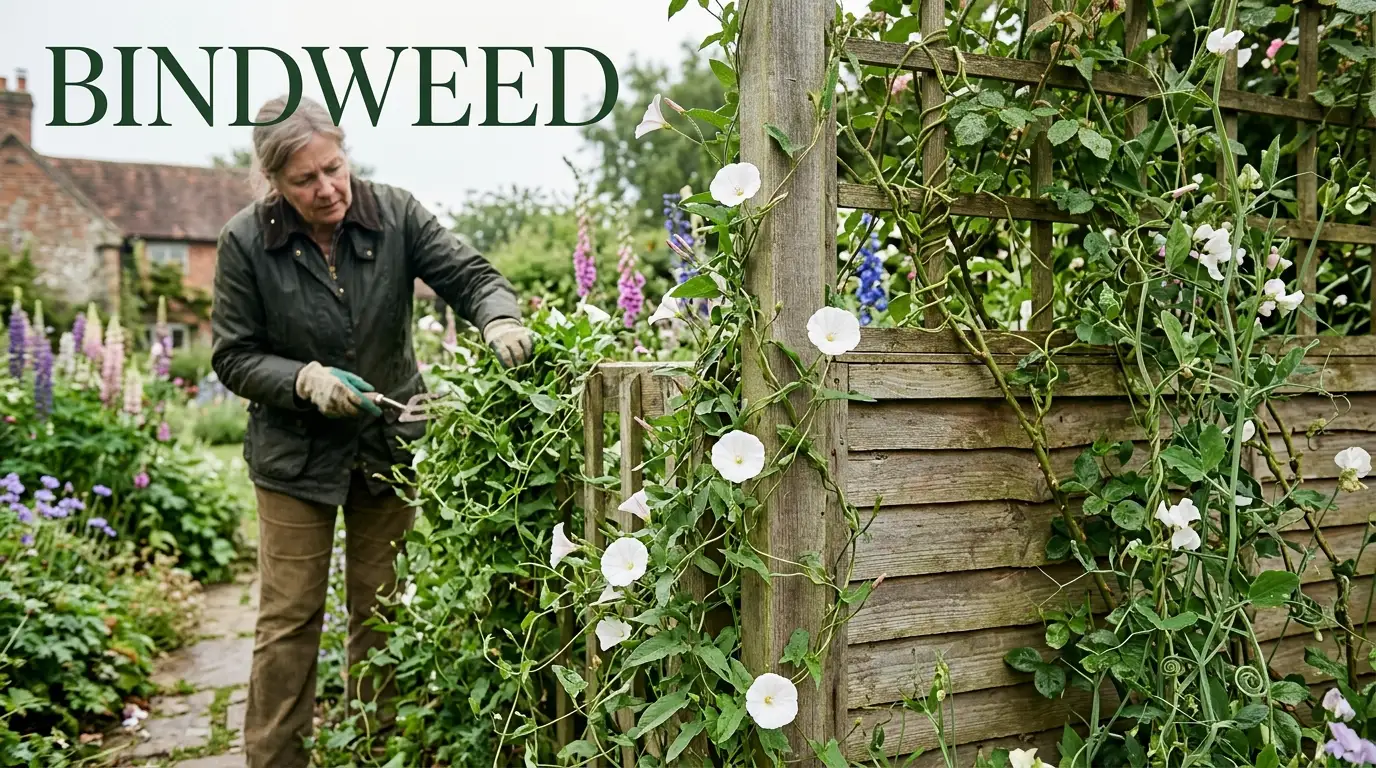
Bindweed is a vigorous perennial climber that can thread through borders, hedges and fences while its pale underground roots spread out of sight. In UK gardens, the two common forms are Calystegia sepium and Convolvulus arvensis. Control works best when you identify the type, avoid chopping the roots, and gradually weaken or remove the root system. For the full picture, read 7 Ways to Prevent Cloudy Glass.
At a Glance
| Feature | Larger hedge form | Smaller field form |
|---|---|---|
| Botanical name | Calystegia sepium | Convolvulus arvensis |
| Typical stems | Can reach about 3m | Usually around 1m or less |
| Leaves | Broad and heart-shaped | Smaller, oval to arrow-shaped |
| Flowers | Usually white, about 5cm wide | White or pale pink, about 2cm wide |
| Growth habit | Strong climber and trailer | Trails or climbs through low plants |
| Root system | Perennial, spreading rhizomes | Perennial, spreading roots |
| Main issue | Can smother shrubs and border plants | Persistent regrowth in beds and open ground |
The RHS identifies both forms as native UK wildflowers with perennial, spreading root systems. Their flowers also provide nectar for pollinating insects.
Short answer: The most reliable non-chemical approach is repeated root removal or light exclusion. Use a fork, not a spade, because small root fragments can regrow. Where roots cannot be lifted, keep cutting new shoots. Persistence matters more than a single dramatic treatment, and established infestations can take years to eradicate.
How to Tell the Two Common UK Types Apart
The larger hedge form, Calystegia sepium, has vigorous twining stems that can reach about 3m. Its heart-shaped leaves can grow to roughly 12cm long. White funnel-shaped flowers, normally about 5cm wide, appear from June to September.
The smaller field form, Convolvulus arvensis, has shorter trailing or climbing stems. Its grey-green leaves are usually oval or arrow-shaped and reach about 6cm. Summer flowers are smaller and may be white, pale pink or striped.
Above-ground growth dies back, but the underground system survives winter. That hidden growth explains why an apparently clear bed can produce fresh shoots again in spring.
Why It Keeps Coming Back
Removing the visible stems does not remove the underground plant. The larger form can develop an extensive root network, with some roots reaching several metres into the soil. Both species can also regenerate from small root pieces. Also worth reading: How to Remove Water Stains From Wood.
This makes aggressive cultivation counterproductive. A rotavator, spade or hoe can cut pale roots into fragments and spread them through a larger area.
Seed can add to the problem. The field form is more likely to set viable seed, although root spread remains a major reason established patches persist.
How to Control Bindweed Without Making It Worse
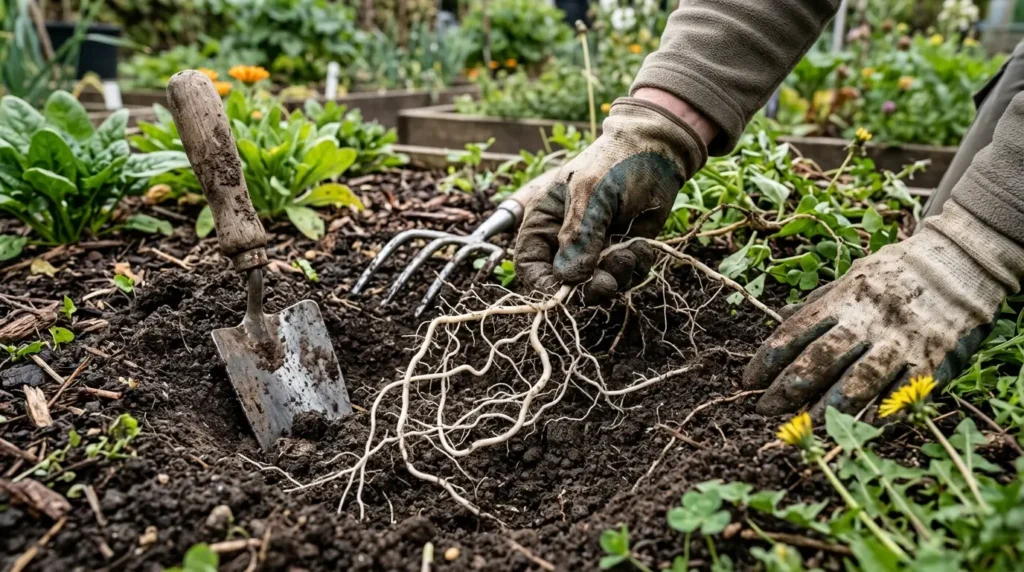
- Fork roots from beds and borders. Push a border fork deeply into the soil and lift gently. Remove pale roots without slicing them into smaller pieces. Winter and early spring are useful times because many border plants are dormant.
- Clean infested root balls before replanting. If the weed has grown through herbaceous perennials, lift those plants when they are dormant. Remove visible white roots, clear the surrounding soil, and replant carefully. Check later growth for pieces you missed.
- Keep removing fresh shoots when digging is impractical. Regular cutting or pulling reduces the leaves feeding the underground system. Repetition can eventually exhaust plants where full root removal is impossible.
- Exclude light from empty ground. The RHS recommends cardboard topped with about 20cm of organic material or heavy biodegradable matting. Gardeners’ World also recommends long-term light exclusion for persistent perennial weeds. Established patches may need prolonged covering.
- Mow affected lawn areas regularly. Repeated mowing prevents strong top growth and gradually weakens the underground system. The process may take several years, but the lawn remains usable as long as control continues.
- Stop roots crossing garden boundaries. The RHS recommends a solid vertical barrier at least 45cm deep where growth enters from neighbouring land. Keep fence lines accessible so emerging shoots remain easy to find.
Access matters in compact gardens. When adding outdoor storage, leaving enough room around fences and shed bases makes future maintenance easier. Writiva’s wooden bike shed guide is useful when planning storage for a small outdoor space.
Boundary access can be especially important when homes are closely packed together. Writiva’s overview of terraced houses and their outdoor spaces provides useful context for these narrower plots.
Mistakes That Can Spread the Problem
Avoid rotating or repeatedly chopping through infested soil because root fragments can regrow. Do not put roots, stems or seed into a normal home compost bin. The RHS recommends council green-waste recycling or an appropriate local recycling site instead.
Vinegar is not an effective answer according to the RHS. HSE also warns that homemade chemical remedies are not automatically risk-free or lawful when used as plant-protection products.
A Practical Year-Round Control Plan
| Time | Main job | Purpose |
|---|---|---|
| Late winter to early spring | Fork out roots and clean dormant perennials | Easier access to beds and root systems |
| Spring and summer | Remove fresh shoots and prevent seed formation | Reduce energy returned to underground roots |
| Autumn | Clear remaining growth and renew light-excluding cover | Prepare the site for the next growing season |
| Year-round | Monitor boundaries and mow affected lawns | Limit reinvasion and weaken persistent plants |
This schedule combines current RHS guidance with Gardeners’ World advice. It also avoids relying on a single treatment to solve a perennial root problem.
Does It Always Need Removing?
Both common species are native wildflowers rather than introduced non-native plants. Their flowers provide nectar for bees, butterflies and hoverflies. The larger form also provides food for several moth caterpillars.
A patch in a wildlife corner or mature hedge may therefore be worth containing rather than eradicating. Control is more useful where stems climb through young shrubs, vegetables or ornamental borders and compete for space and light.
When Chemical Control Is Considered in Great Britain
Non-chemical methods should come first. The RHS considers them effective, although established roots demand patience. If you choose a pesticide in Great Britain, HSE says the product must be authorised for its intended use. You are legally responsible for following its label. HSE also recommends checking its current garden database before using stored or internet-bought products.
As of August 2026, HSE states that glyphosate’s GB active substance approval has been extended to 15 December 2026, while its renewal assessment continues. That does not mean every product or garden use is authorised, so check the specific product before use.
Make the Next Growing Season Easier
Start by marking each place where shoots emerge. Decide whether that area needs careful root removal, repeated cutting, mowing or light exclusion. Then check the same locations whenever you work nearby.
For more ideas on maintaining and improving outdoor areas around the home, browse Writiva’s latest home-improvement content.
Frequently Asked Questions
Both common UK species can spread through persistent underground roots and regenerate from fragments. The field form is also more likely to produce viable seed. In cultivated areas, their twining growth can compete with and smother valued garden plants.
No. A typical domestic compost heap may not reach high enough temperatures to destroy persistent roots. The RHS recommends using council green-waste recycling or a suitable recycling facility instead.
One removal will not eliminate an established root system. Regular cutting or pulling can still be useful when digging is impossible because repeated removal gradually weakens underground reserves.
Expect a long-term job rather than an instant cure. Gardeners’ World recommends extended light exclusion for perennial weeds, while the RHS says heavily established patches may need covering for a few years.

