The 1920s silhouette was a tube. Waistlines slid from the natural waist down to the hip between roughly 1920 and 1923, the bust was flattened rather than shaped, and hemlines rose from the ankle to just below the knee, reaching their shortest around 1926 and 1927 before dropping again in 1929. That is the whole shape of the decade in one sentence, and almost everything else — the beading, the bob, the cloche hat, the long ropes of pearls — follows from it.
What that summary leaves out is that the change was driven as much by economics and labour as by taste. A corseted Edwardian outfit needed a second pair of hands to fasten. A dropped-waist chemise dress could be pulled over the head, cut from rectangles, and made at home from a paper pattern — which mattered enormously in a Britain where domestic service was collapsing and unemployment stayed stubbornly high through most of the decade.
A timeline of the decade
| Year | What happened | Why it mattered |
|---|---|---|
| 1919 | Jean Patou reopened his Paris house after war service; Britain entered a short post-war boom | Sportswear entered couture as a serious category |
| 1921 | Chanel No. 5 launched | A couture house proved that fragrance could fund the clothes |
| 1922 | Howard Carter opened Tutankhamun’s tomb in November; the Prince of Wales wore a Fair Isle jumper at St Andrews | Egyptian motifs flooded jewellery and textiles; Fair Isle knitwear became fashionable menswear |
| 1923 | Madeleine Vionnet reopened her house in Paris | The bias cut began its spread from couture towards the mainstream |
| 1924 | Plus fours were banned at Oxford and Cambridge lectures; the American trade settled on the name rayon for artificial silk | Two of the decade’s odder legacies: Oxford bags, and cheap stockings |
| 1925 | The Exposition Internationale des Arts Décoratifs opened in Paris; the Charleston reached Britain | The decorative language later called Art Deco went global; dance demanded clothes that moved |
| 1926 | Chanel’s little black dress appeared in American Vogue; the General Strike paralysed Britain in May | Vogue nicknamed the dress Chanel’s Ford; the British twenties were not roaring for everyone |
| 1927 | Elsa Schiaparelli’s trompe-l’oeil bow jumper; Lanvin launched Arpège | Wit entered fashion as a selling point |
| 1928 | The Equal Franchise Act gave British women the vote at 21 | The 1929 election was nicknamed the Flapper Election |
| 1929 | Hems dropped, waists began returning; Wall Street crashed in October | The tubular line was already on its way out before the crash finished it |
Two things stand out from that list. The visual language we now call twenties was concentrated in a very narrow window — roughly 1924 to 1928. And the British experience of the decade barely resembles the American one, which is why so much popular imagery of the period is misleading here.
The economics under the silhouette
Britain did not have a decade-long boom. It had a brief restocking boom in 1919 and 1920, then a sharp slump, and unemployment sat above a million for most of the years that followed. The return to the gold standard in 1925 at the pre-war parity made British exports expensive, the coal industry cut wages, and the General Strike followed in May 1926. Against that backdrop, the appeal of a dress that used less cloth, needed no boning, no complicated fitting and no second person to fasten it becomes very easy to understand.
The other structural change was labour. Domestic service, which had employed well over a million people in Britain before the war, shrank as women who had taken factory and clerical work during the war declined to go back to it. Fewer households had a maid, and a garment that a woman could get into unaided stopped being a convenience and became a requirement. At the same time, mass-produced paper dress patterns and improving ready-to-wear made the Paris line copyable within a season by anyone with a sewing machine. That, more than any designer, is why the look spread so fast down the social scale.
The flapper: what the myth gets wrong
The word flapper was British slang for a young girl well before 1920, and by the mid-twenties it described a specific and quite small group: young, urban, unmarried, mostly middle-class women with disposable income, who went dancing. They were a visible minority who attracted enormous press attention, in much the way that any subculture does, and newspapers of the period wrote about them with a mixture of alarm and fascination that had very little to do with how the average woman in Salford or Swansea dressed.
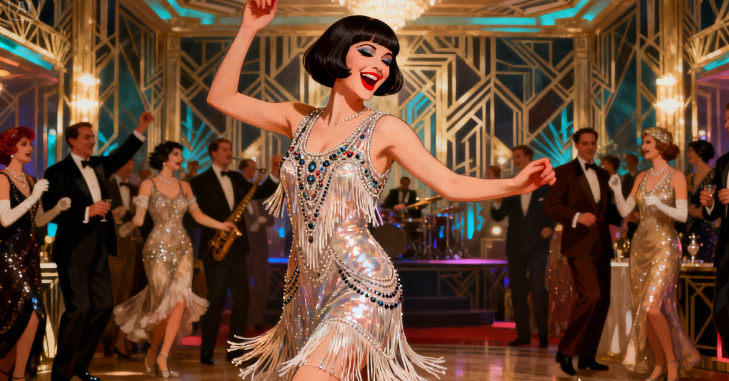
The ordinary 1920s wardrobe was a straight, dropped-waist day dress in wool or cotton, worn with stockings and a low-heeled shoe and a cloche hat, and it was worn until it wore out. Fully beaded evening dresses were expensive and were owned by a small fraction of women. The image most people carry — short fringed dress, feather headband, long cigarette holder — is substantially a later Hollywood construction, refined through costume drama from the 1930s onwards and cemented by film adaptations of the 1970s. Feather headbands in particular were far rarer in the 1920s than in any fancy dress shop today. If you want to see what people actually wore, look at photographs from local archives rather than at films.
The designers who changed the shape
Gabrielle Chanel
Chanel’s contribution was material and attitude rather than silhouette alone. She built day clothes out of wool jersey — a knitted cloth previously used for underwear and men’s sportswear — which draped over the body instead of being constructed around it. She made costume jewellery something to wear openly rather than to pass off as real, launched Chanel No. 5 in 1921, and in 1926 published the plain black dress that American Vogue nicknamed Chanel’s Ford, predicting it would become a uniform for women of taste. The prediction was right, and the little black dress is the single most durable garment idea of the decade.

Jean Patou
Patou reopened his house in 1919 and made sport the organising idea of a wardrobe rather than a niche within it. He designed a sleeveless, knee-length tennis outfit for Suzanne Lenglen, the dominant player of the era, which she wore in competition in the early 1920s — at a moment when women still played in long skirts and sleeves. He put monograms on knitwear, effectively inventing the visible designer logo, and at the end of the decade he was among the first to lengthen skirts again, helping to close the era he had helped define.
Jeanne Lanvin and the robe de style
Not every 1920s dress was a tube, and the robe de style is the proof. Lanvin’s signature evening shape kept the fashionable dropped waist but attached a full, wide skirt, often supported with panniers borrowed from eighteenth-century dress. It was the option for women whose figures the tubular line did not flatter, and for formal occasions where a straight chemise looked too casual. It sold consistently through the whole decade, which tells you the flapper line was never universal even among women who could afford couture. Lanvin launched Arpège in 1927.
Vionnet, Delaunay and the decline of Poiret
Madeleine Vionnet reopened her Paris house in 1923 and pursued the bias cut — cutting cloth at 45 degrees to the grain so it stretched and clung without darts or boning. It is the technique that made the fluid 1930s possible, and it began here. Sonia Delaunay brought abstract geometry to textiles and showed her Boutique Simultanée at the 1925 exposition, blurring painting and dressmaking. Paul Poiret, meanwhile, is the cautionary figure: the designer who had loosened the corset before the war could not adapt to the new austerity of line, and his house closed in 1929.
How a 1920s dress was actually made
Handle an original and the first surprise is how simple the construction is and how heavy the good ones are. A fully beaded evening dress can weigh two to four kilograms, which is why so many survivors have split at the shoulders — the weight of glass beading gradually tears fine silk chiffon.
- Cut from rectangles. Many day dresses are essentially two panels seamed at the sides with an opening for the head. Shaping is minimal and often achieved with a tie or a sash at the hip rather than a seam.
- No zips. Metal zips did not enter mainstream dressmaking until the 1930s. Twenties garments use press studs, hooks and eyes, side plackets, or nothing at all because they pull over the head.
- The waist seam sits at the hip, generally somewhere between 1922 and 1929, and the bodice above it is deliberately unshaped.
- Beading was applied by hand, usually with a tambour hook onto a stretched net or chiffon ground, often by workers in France and increasingly by outworkers elsewhere. It was slow, and it is why the dresses were expensive.
- Hems were frequently uneven by design — handkerchief points, scalloped edges and floating panels for evening, which read as movement when dancing.
- Day hems were not that short. Even at the shortest point around 1926 to 1927, a fashionable day skirt hovered around the knee, not above it.
Fabrics and the technology that made them
The decade sits at a genuine turning point in textiles, because regenerated cellulose fibres moved from novelty to mass market. Courtaulds had produced the first commercial viscose rayon in Britain in 1905; by the 1920s it was cheap, widely available, and doing to silk stockings what nothing else had managed.

| Fabric | What it is | Where it appears |
|---|---|---|
| Silk chiffon and georgette | Very fine, sheer, light plain-weave silks | Beaded evening dresses, floating overlayers |
| Crêpe de Chine | Silk with a slight matte grain and good drape | Day dresses, blouses, linings |
| Wool jersey | Knitted rather than woven, stretches, was previously underwear cloth | Chanel day dresses, cardigan suits |
| Silk velvet | Cut pile, heavy, catches light | Evening coats, capes, cloche hats |
| Lamé | Cloth woven with metal-wrapped thread | Evening dresses and coats, at the expensive end |
| Viscose rayon (artificial silk) | Regenerated cellulose from wood pulp | Stockings, linings, affordable copies of couture dresses |
| Tulle and net | Open mesh | Robe de style skirts, and as the ground for beadwork |
Underwear: what the tubular line required
The corset did not vanish so much as change job. Instead of pulling the waist in and pushing the bust up, 1920s foundation garments flattened the chest and smoothed the hip so that a straight dress hung cleanly. The British contribution here is concrete: Symington, the corsetry firm in Market Harborough in Leicestershire, produced the Symington Side Lacer, a bandeau-style brassiere laced at the sides to compress the bust, and surviving examples are held in the Symington collection in Leicestershire. Alongside it women wore lightweight girdles or corselettes, camiknickers combining a camisole and knickers in one, and stockings held with suspenders — rolled below the knee at some points in the decade, which is where the image of rolled stockings comes from. What almost nobody wore was anything resembling a modern shaped bra.
Hair, hats and faces
The bob predates the twenties — the dancer Irene Castle had popularised a short cut in the mid-1910s — but it became general in this decade, and it went progressively shorter: the classic bob to the jaw, then the shingle tapered into the nape, then the Eton crop, cropped close like a schoolboy’s. The Polish-born Paris hairdresser Antoine is the name most associated with popularising it. Cutting your hair was read as a statement, and there are documented cases of women being sacked or thrown out of home for it. The cloche hat, credited to the Paris milliner Caroline Reboux, was designed to be pulled down to the eyebrows over exactly that short hair — which is why cloches do not sit correctly on long hair, and why the hat and the haircut arrived together. If you want the modern descendants of those shapes, our guide to short cuts and how they are worn now traces the line from the bob forward. Cosmetics became publicly acceptable in the same decade, helped considerably by the film industry: powder compacts, dark kohl-rimmed eyes, and a small, sharply drawn cupid’s bow mouth that has almost no equivalent in any other period.
Menswear: the lounge suit wins
The men’s story of the 1920s is the final defeat of formal Victorian dress by the lounge suit. The frock coat became something worn by older men and at ceremonies; the three-piece lounge suit, in narrow chalk stripe or plain worsted, became the standard for business. Trousers were cut fuller than before, jackets softer, and turn-ups on trousers moved from a country affectation to normal. Summer brought lighter cloth, the boater and, at the fashionable end, the two-tone shoe.
Two specifics are worth knowing. Oxford bags emerged among Oxford undergraduates in the mid-1920s: extremely wide trousers measuring roughly 22 to 23 inches around the hem at first, and later, in extreme versions, far wider. The often-repeated story is that they were adopted to hide plus fours after the 1924 ban on wearing plus fours at lectures — a good story that the early narrower versions do not really support. Sportswear came into everyday male dress at the same time: plus fours for golf, and the Fair Isle jumper, which entered fashion after the Prince of Wales was seen in one at St Andrews in 1922. Both the wide trouser and the patterned knit came from a small, privileged group and moved outward, the reverse of how the women’s silhouette spread.

Where the decoration came from
The ornamental vocabulary of the decade — stepped zigzags, sunbursts, stylised lotus and scarab motifs, geometry over botany — has two clear sources. The Exposition Internationale des Arts Décoratifs et Industriels Modernes, held in Paris in 1925, gathered and broadcast a modern decorative style across furniture, jewellery, graphics and dress; the term Art Deco itself was applied retrospectively decades later. And the opening of Tutankhamun’s tomb in November 1922 set off a wave of Egyptian-influenced design that reached jewellery, textile prints, cinema interiors and even biscuit tins. When you see a 1920s beaded panel arranged in stepped triangles, you are looking at the meeting of those two events.
Assembling an accurate 1920s look in the UK today
Most twenties party outfits fail on the same three points: the waist is in the wrong place, the fabric is too stiff, and the accessories come from a 1970s idea of the period. Fixing those gets you most of the way there without spending much.
| Element | What is accurate | What to avoid | Where to look in the UK |
|---|---|---|---|
| Dress | Straight cut, seam or sash at the hip, hem at or just below the knee, soft drapey fabric | Fitted natural waist, stiff satin, hem well above the knee | Vintage fairs, specialist repro makers, charity shops in wealthier towns |
| Beading | Hand-applied on chiffon or net; heavy; matte and glass rather than plastic-bright | Plastic sequin sheeting sewn in horizontal rows | Original pieces at auction, or good reproduction lines |
| Stockings | Sheer, seamed, held with a suspender belt; often rolled | Opaque black tights | Repro hosiery specialists and dancewear suppliers |
| Shoes | Low block or Louis heel, T-bar or single strap, closed toe | Stilettos, platforms, anything pointed | Repro dance shoe makers; original 1920s shoes rarely fit modern feet |
| Head | Cloche pulled to the eyebrows, or a narrow beaded bandeau across the forehead | Large feather headband | Vintage hat dealers, milliners |
| Jewellery | Long single or double rope of pearls, geometric paste, a single bangle | Multiple layered modern necklaces | Antiques centres, vintage costume jewellery dealers |
| Hair | Bob, shingle or Eton crop; long hair pinned into a faux bob at the nape | Loose curls down the back | Any salon, or pin curls and grips at home |
| Makeup | Matte pale powder, dark defined eye, small cupid’s bow lip | Contouring, glossy lip, heavy blusher on the apples | High street; a matte powder and a dark brown liner is the whole kit |
On cost: original beaded 1920s evening dresses in wearable condition typically run into the low hundreds of pounds at UK vintage dealers and specialist auctions, and fragile ones sell for less precisely because they cannot be worn. Good reproduction dresses generally sit in the tens to low hundreds. An original cloche in decent condition is usually a modest sum from a vintage hat dealer. Prices move constantly, so treat these as orders of magnitude rather than quotations. If the occasion is a formal one and you want the period feel without a costume, a straight-cut dress with a dropped sash is the bridge — our guides to what counts as a cocktail dress and how cocktail dress codes work cover where the line sits, and winter wedding guest dressing is where a 1920s-inflected shape most often turns up in real life.
The five giveaways of an inaccurate 1920s costume

- A waist at the waist. This is the single biggest tell. If the seam or the sash sits above the hip bone, it is not a 1920s line.
- A stiff fabric. The period depended on chiffon, georgette, crepe and jersey, all of which move. Structured satin holds a shape the decade was actively trying to abandon.
- A very short hem. Fancy dress hems sit mid-thigh. Real ones sat around the knee, and only for a few years.
- The feather headband. Overwhelmingly a modern shorthand. A cloche or a narrow beaded bandeau is more accurate and looks better.
- A long cigarette holder as an accessory. They existed, but their ubiquity in costume comes from film, not from photographs of ordinary people.
How the decade ended
The change was already under way before the crash. From about 1928 designers began dropping hems and letting the waist creep back towards its natural position, and by 1929 the fashionable evening line was long, bias-cut and body-skimming — recognisably the 1930s. The Wall Street crash in October 1929 and the depression that followed accelerated a return to longer, more sober, more obviously feminine clothing, and the twenties look was over commercially within about two years. What survived is not the beading but the underlying principles: clothes cut to move with the body rather than to reshape it, sportswear treated as serious dress, and the plain dark dress that goes anywhere. Those ideas have never really gone away.
Jazz clubs and nightlife were central to the decade’s style. Vibrant music inspired dynamic clothing designs, fringe movement, bold colors, and accessories that allowed freedom of motion. Jazz culture also reinforced youth rebellion and modern self-expression.
Fashion mirrored major societal shifts: women’s suffrage, urbanization, and economic growth. Clothing and hairstyles allowed women to express independence, challenge traditional gender roles, and embrace nightlife culture, while men’s Fashion reflected modernity and social status.
Men moved from rigid, slim-cut suits to relaxed tailoring, high-waisted wide-leg trousers, double-breasted jackets, and patterned fabrics like pinstripes. Casual and sportswear, including knickers and knitted sweaters, also became popular, reflecting the influence of urban culture and leisure activities.
The 1920s introduced the iconic flapper dress, characterized by dropped waists, knee-length hemlines, loose fits, and decorative elements such as fringe, beads, and sequins. Women also embraced bobbed haircuts, bold makeup, and accessories such as cloche hats and long pearl necklaces, symbolizing independence and liberation.