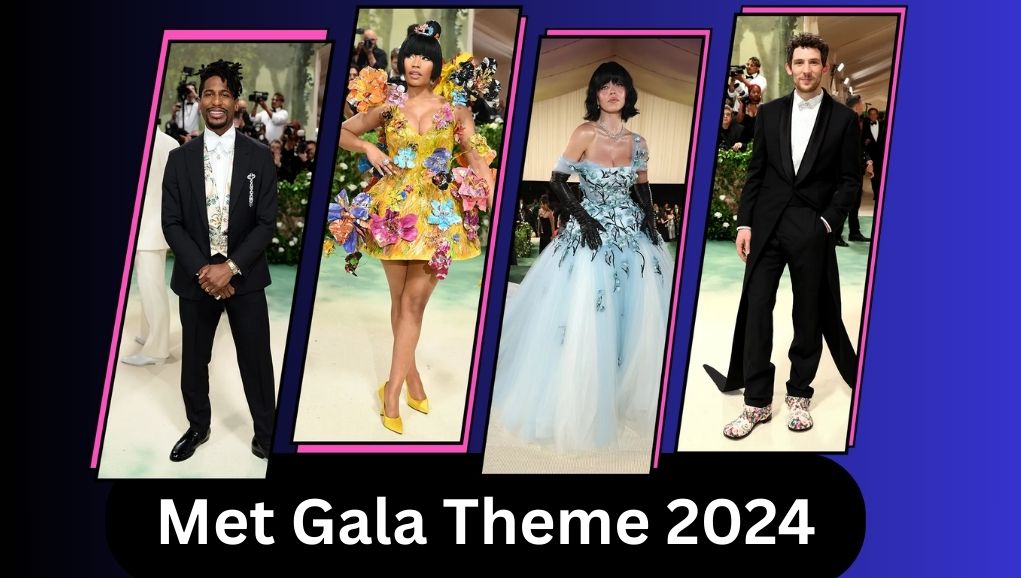
The 2024 Met Gala had two names, and knowing the difference is the whole answer. The exhibition theme was Sleeping Beauties: Reawakening Fashion. The dress code guests were actually asked to follow was The Garden of Time, taken from a 1962 J.G. Ballard short story. The gala was held on Monday 6 May 2024 at the Metropolitan Museum of Art in New York, and raised a then-record sum of more than 26 million dollars.
Co-chairs were Zendaya, Jennifer Lopez, Bad Bunny and Chris Hemsworth, with Anna Wintour as ever at the centre of it. If you have arrived here in 2026 wanting this year’s theme instead, that is Costume Art with a dress code of Fashion is art — the full comparison with 2025 is further down.
Theme versus dress code: why there were two names
Every year the Met Gala announces an exhibition title and, separately, a dress code. The exhibition title describes what the Costume Institute is actually putting on display for the following months. The dress code is the instruction to guests, and it is usually looser and more evocative, because asking a hundred celebrities to dress as a museum exhibition would produce something unwearable.
In 2024 the gap between the two was unusually wide, which is why so much coverage got them confused. Sleeping Beauties: Reawakening Fashion was about garments too fragile to be worn again. The Garden of Time was about a walled garden of crystal flowers being picked one by one. They connect through the idea of beauty that decays, but a guest reading only the first title would have dressed very differently from one reading the second.
| Element | 2024 detail |
|---|---|
| Exhibition theme | Sleeping Beauties: Reawakening Fashion |
| Dress code | The Garden of Time |
| Date | Monday 6 May 2024 |
| Venue | Metropolitan Museum of Art, New York |
| Co-chairs | Zendaya, Jennifer Lopez, Bad Bunny, Chris Hemsworth |
| Honorary chairs | Shou Zi Chew, Jonathan Anderson |
| Sponsors | TikTok and Loewe |
| Ticket price | Reported at 75,000 dollars per seat |
| Raised | More than 26 million dollars, a record at the time |
The Garden of Time: the story behind the dress code
J.G. Ballard published The Garden of Time in 1962. Count Axel and his wife live in an elegant villa surrounded by crystal flowers while an enormous, ragged mob advances slowly across the plain towards them. Each time Axel picks one of the flowers, time reverses and the mob is pushed back to the horizon. The flowers are finite. He picks them one by one until there are none left, and the mob arrives.
It is a story about aristocratic beauty holding off the future for exactly as long as its resources last, and no longer. As a brief for a fashion gala it is remarkably bleak, and the guests who engaged with it seriously produced the night’s best looks: things that appeared to be decaying, disappearing, or made of material that could not survive the evening. Guests who read it as simply wear flowers produced the ones critics dismissed.
What the Sleeping Beauties exhibition actually was
The exhibition, curated by Andrew Bolton, ran from 10 May to 2 September 2024. It gathered roughly 250 items, with more than 220 pieces spanning the 17th century to autumn 2024 collections, and was the largest Costume Institute show ever assembled exclusively from works already in the museum’s own collection, supplemented by 75 new acquisitions.
The premise was genuinely melancholy. Bolton’s argument was that when a garment enters a museum collection its status changes irrevocably: what was a living part of someone’s experience becomes a motionless artwork that can no longer be worn, heard, touched or smelled. Some pieces were so fragile they could not be placed on a mannequin at all and had to lie flat in cases, which is where the sleeping beauty image comes from.
The show’s response was to try to reawaken the senses the objects had lost. It used 3D-printed replicas visitors could handle, wallpaper embossed with embroidery patterns, recordings made in an anechoic chamber so you could hear fabrics that can no longer be moved, projections, scratch-and-sniff scent panels, an AI chatbot, and a Loewe overcoat growing real grass that had to be replaced weekly. The organising metaphor was sea, land and sky.
- Around 250 objects, over 220 from the 17th century to autumn 2024.
- Largest ever Costume Institute show drawn wholly from the museum’s own holdings.
- 75 new acquisitions added for the exhibition.
- Ran 10 May to 2 September 2024, roughly sixteen weeks.
- Sensory reconstruction through sound, scent, touch and projection rather than display alone.
The looks that actually interpreted the brief
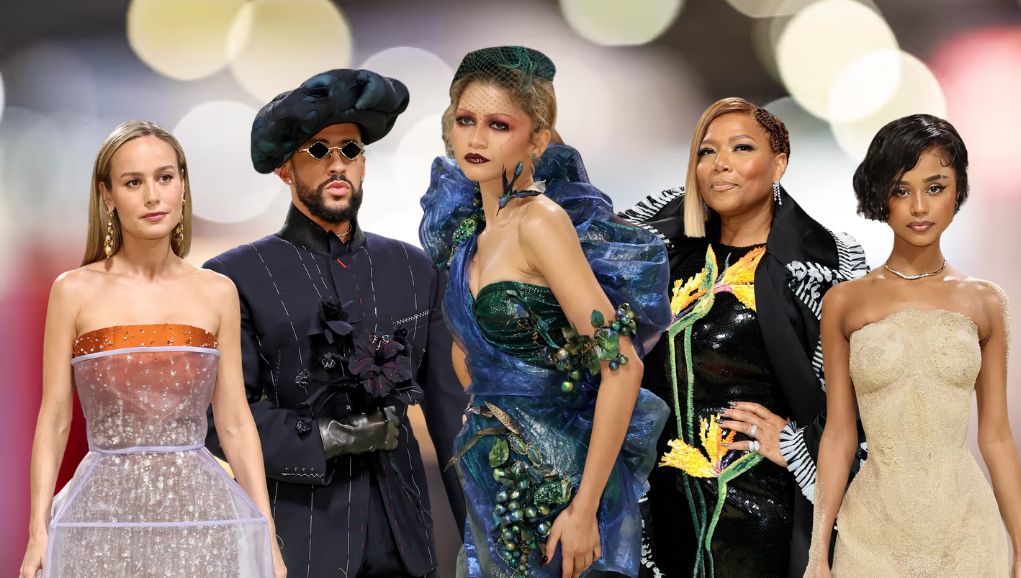
The red carpet split into those who understood that the theme was about decay and those who turned up in floral print. These were the ones that worked.
| Guest | Designer | The look |
|---|---|---|
| Zendaya (co-chair) | Maison Margiela Artisanal, then archive Givenchy | Two looks; the only guest to change |
| Tyla | Balmain | Fitted gown made to resemble a sand sculpture, with an hourglass clutch |
| Lana Del Rey | Alexander McQueen | Veiled, with an antlered headpiece nodding to the house’s autumn/winter 2006 collection |
| Gigi Hadid | Thom Browne | Three-dimensional floral ballgown |
| Jennifer Lopez (co-chair) | Schiaparelli | Sheer, heavily embellished sparkling gown |
| Bad Bunny (co-chair) | Maison Margiela | Sculptural tailoring |
| Chris Hemsworth (co-chair) | Tom Ford | Sleek tailored suit |
| Cardi B | Windowsen | Vast black gown that reportedly needed eight handlers on the steps |
| Lily Gladstone | Indigenous design | Nearly 500 silver stars set as summer-solstice constellations |
| Elle Fanning | Balmain | Pale, delicate construction in keeping with the fragility brief |
Tyla’s Balmain dress is the one most often cited as the night’s best answer to the brief, because it was literally made to look like sand and she reportedly had to be carried up the stairs in it. A garment that cannot be moved in is precisely what the exhibition was about.
Zendaya’s two looks, in detail
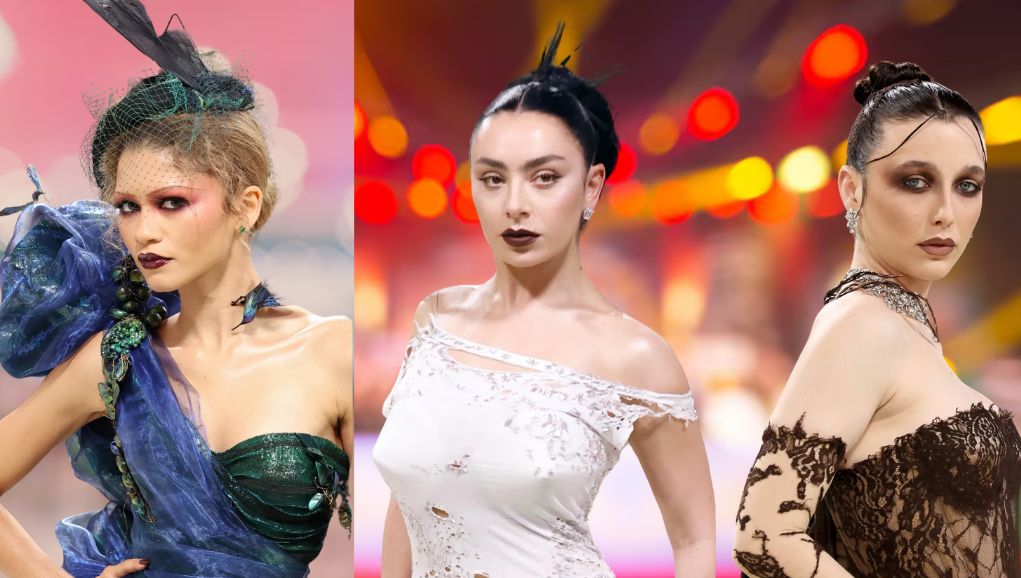
As co-chair and after a five-year absence from the event, Zendaya was styled by Law Roach and appeared twice. The first was a custom Maison Margiela Artisanal gown, worn with dark eyes and a vampy lip. The second, later in the evening, was an archival black Victorian-inspired gown from John Galliano’s spring 1996 collection for Givenchy, worn with bleached brows, a natural lip and lilac eyeshadow.
The second look was finished with a headpiece by Philip Treacy for Alexander McQueen, circa 2007, a bouquet of roses wrapped in black fabric. Pairing a 1996 Galliano couture piece with a 2007 Treacy headpiece was itself an argument about the exhibition: these are archive objects being woken up and worn again, which is the one thing the garments in the museum can never do.
What the critics made of it
Reception was mixed, and it is worth being honest about that rather than describing the night as a triumph. The Guardian called the exhibition a feast for the senses. The Washington Post criticised its convoluted approach to technology, and The New York Times likened it to a fun house. The gala itself drew a fair amount of comment that it was, by Met Gala standards, boring.

The 2024 event also ran alongside a social media campaign urging users to block celebrities who had attended, on the grounds that the spectacle was tone-deaf against the news agenda of that spring. Whatever one makes of it, the reaction was a notable part of how the night was received and is usually omitted from recaps.
How 2024 compares with the themes either side
Placing it in sequence is the quickest way to see what the Costume Institute has been doing. The exhibition theme is listed first, the guest dress code second where they differed.
| Year | Exhibition theme | Dress code | Co-chairs |
|---|---|---|---|
| 2019 | Camp: Notes on Fashion | Camp | Lady Gaga, Harry Styles, Serena Williams, Alessandro Michele |
| 2023 | Karl Lagerfeld: A Line of Beauty | In honour of Karl | Dua Lipa, Michaela Coel, Penelope Cruz, Roger Federer |
| 2024 | Sleeping Beauties: Reawakening Fashion | The Garden of Time | Zendaya, Jennifer Lopez, Bad Bunny, Chris Hemsworth |
| 2025 | Superfine: Tailoring Black Style | Tailored for you | Pharrell Williams, ASAP Rocky, Lewis Hamilton, Colman Domingo |
| 2026 | Costume Art | Fashion is art | Beyonce, Nicole Kidman, Venus Williams |
The trajectory is clear enough. 2023 was a designer retrospective, 2024 was conceptual and about the objects themselves, 2025 turned to a specific cultural history with Superfine: Tailoring Black Style and an honorary chair in LeBron James, and 2026 has gone broad and declarative with Costume Art.
If you are here for the 2026 theme
A great deal of search traffic for old Met Gala theme pages is actually people looking for the current year, so here it is directly. The 2026 theme is Costume Art, with the dress code Fashion is art. Co-chairs are Beyonce, Nicole Kidman and Venus Williams, alongside Anna Wintour, with Jeff and Lauren Sanchez Bezos as honorary chairs and also among the sponsors, together with Saint Laurent.
Tickets were reported at 100,000 dollars per seat, up from 75,000 dollars in both 2024 and 2025, and the event raised a record 42 million dollars. That is a considerable jump on the 26 million raised in 2024, which had itself been a record. The exhibition also coincides with major new galleries at the Met dedicated to showing fashion as art.
How the theme is chosen, and who pays for it
The gala is the Costume Institute’s annual fundraiser and is organised in conjunction with Vogue. Anna Wintour has chaired or co-chaired it every year since 1995 with the single exception of 1996. The theme is not chosen to generate red-carpet content; it is set by whatever exhibition the Costume Institute is mounting that spring, and the dress code is then written to give guests something interpretable.
Funding comes from ticket sales, corporate sponsorship and tables bought by fashion houses, which is why sponsors change each year and why the sponsoring house tends to dress a disproportionate number of guests. In 2024 the sponsors were TikTok and Loewe. Money raised funds the Costume Institute’s exhibitions, acquisitions and conservation work for the year, which is the direct link between an evening of dressing up and the 75 new acquisitions the exhibition contained.
Watching from the UK
The Met Gala is held on the first Monday in May, in New York. New York is five hours behind the UK during British Summer Time, so the red carpet, which typically begins around 6pm Eastern, starts around 11pm in the UK and runs well past midnight. This is why British coverage is almost always next-morning rather than live.
There is no full UK broadcast of the event itself, because there is nothing to broadcast: once guests are inside, phones have historically been discouraged and the dinner is not televised. What circulates is the carpet arrivals, official Vogue imagery and whatever guests choose to post afterwards. If you are planning to follow it live from the UK, the arrivals are the event.
Common mistakes people make about the 2024 theme
- Calling the theme The Garden of Time. That was the dress code; the theme was Sleeping Beauties: Reawakening Fashion.
- Assuming it was a garden party brief. The Ballard story is about a garden being destroyed, not celebrated.
- Thinking the gala and exhibition are the same event. The gala on 6 May opened an exhibition that then ran until 2 September.
- Believing the theme is picked by Vogue for the carpet. It follows the Costume Institute’s exhibition schedule.
- Assuming everyone wore florals. The most praised looks were about fragility and decay, not flowers.
- Mixing up 2024 and 2025. Superfine: Tailoring Black Style was 2025, a completely different premise.
The short version
The 2024 Met Gala, on 6 May, marked the opening of Sleeping Beauties: Reawakening Fashion, an exhibition about garments too fragile ever to be worn again. Guests were given the dress code The Garden of Time, after Ballard’s story about a man picking crystal flowers to hold back the inevitable. It raised over 26 million dollars, produced two of the decade’s most discussed red-carpet looks in Zendaya’s Margiela and archive Givenchy, and was received with rather more scepticism than most recaps admit.
For more on dressing to a brief, see our guides to what cocktail attire actually means and 1920s fashion and how it is reinterpreted today. For pieces with a similar red-carpet lineage, read our take on styling a satin skirt, and for finishing touches, our roundups of seasonal nail colours and the best lip plumpers in the UK.
The theme was “Fashion Beyond Boundaries,” encouraging creativity, cultural expression, and futuristic designs. Attendees interpreted it with innovative silhouettes, avant-garde accessories, and bold, imaginative styling.
Celebrities such as Zendaya, Rihanna, Timothée Chalamet, Billie Eilish, and Harry Styles attended, collaborating with designers to showcase striking, high-fashion outfits aligned with the gala’s theme.
Designers created couture gowns, tailored suits, statement accessories, and experimental ensembles. Their work emphasized originality, creativity, and thematic storytelling, enhancing both the impact of fashion and media attention.
The gala influenced fashion trends worldwide, introducing metallic fabrics, structured silhouettes, layered textures, and bold statement pieces, inspiring fans, media, and designers to experiment creatively.
The event celebrates diversity, heritage, and global artistry while supporting the Costume Institute. It merges entertainment and fashion, inspiring creativity, public engagement, and innovative couture worldwide.