A leather trench is a trench-coat silhouette — belted waist, storm flap, notched lapels, long line — cut in hide or a leather substitute rather than cotton gabardine. The decision that matters is not the styling but the material and the hem length: real lambskin from a British contemporary label runs roughly £400 to £800 and will still be wearable in fifteen years, while a good faux version from the high street sits around £70 to £130 and realistically gives you two to four seasons before the coating starts to flake.
The second thing that decides whether it works is length relative to your height. A full 125cm coat on someone who is 5ft2 reads as fancy dress; the same coat on someone 5ft10 reads as expensive. Everything below is organised around those two calls — what to spend, and what to have shortened.
Price tiers in the UK, and what each one actually buys
| Tier | Typical UK price | What it is made of | Realistic lifespan |
|---|---|---|---|
| Fast fashion | £45–£90 | Thin PU or PVC on polyester backing | 1–2 winters before creasing and flaking |
| High street | £90–£180 | Heavier PU, often croc-embossed, proper lining | 3–5 winters with careful storage |
| Contemporary real leather | £350–£800 | Lambskin or light nappa, viscose or cupro lining | 10–20 years with conditioning |
| Premium / designer | £800–£2,000 | Heavier hides, hand-finished edges, made in Italy or Turkey | A lifetime; it outlives the trend cycle |
| Heritage luxury | £3,000+ | House-specific hides and construction | Effectively permanent, resells well |
Two honest observations about that table. The jump that gives you the most for your money is from fast fashion to high street — roughly doubling the spend roughly triples the wear. The jump from contemporary real leather to designer buys you finishing and provenance rather than durability; a £600 lambskin coat and a £1,800 one will both survive you if you look after them.
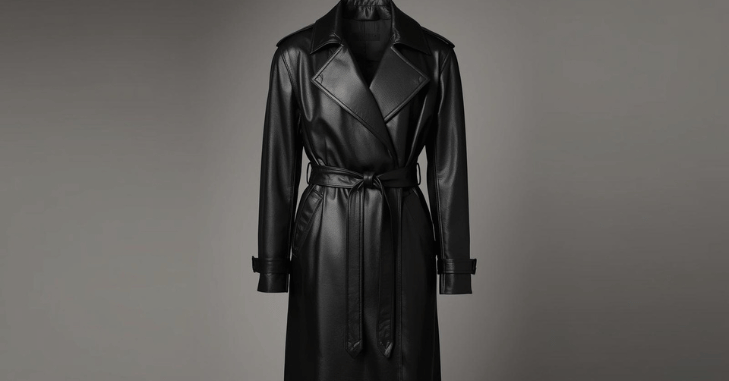
Length and fit by height
Trench length is measured from the centre back neck seam to the hem, and brands are wildly inconsistent about what they call long. Ask for the actual measurement in centimetres before ordering online — most UK retailers will give it if you ask, and the good ones publish it.
| Your height | Hem should fall | Centre-back length to look for | What to avoid |
|---|---|---|---|
| Under 160cm (5ft3) | Just above or on the knee | 85–100cm | Anything past mid-calf; it swallows the leg line |
| 160–170cm (5ft3–5ft7) | Knee to just below | 100–110cm | Hems that stop at the widest part of the calf |
| 170–178cm (5ft7–5ft10) | Below the knee to mid-calf | 110–120cm | Cropped versions, which read as a jacket |
| Over 178cm (5ft10+) | Mid-calf or lower | 120–132cm | Sleeves that finish above the wrist bone |
Three fit rules that matter more than the size on the label. Sleeves should end at the wrist bone when your arms hang down, measured while wearing a jumper — leather sleeves can be shortened but it is fiddly and costs money. Shoulders on a trench are meant to sit slightly wide; a seam 2 to 4cm past your natural shoulder point is correct, not a mistake. The belt should be able to fasten comfortably over a chunky knit with room to spare, because that is the only way you will wear it between November and February.
Body shape: where the belt goes
A belted trench creates a waist wherever you tie it, which makes it one of the more democratic coat shapes. If you carry weight around the middle, wear it open with the belt tied at the back rather than cinched at the front — the vertical lines of the storm flap and lapels do the work. If you are short-waisted, tie the belt a couple of centimetres lower than the belt loops suggest. If you are long-waisted, tie it higher. If you have a fuller bust, a single-breasted or wrap style sits flatter than a double-breasted one, which adds bulk exactly where you do not want it. Nobody will notice the belt loops are not where the knot is.
Real leather, faux leather, and what each one costs you over ten years

Real garment leather for coats is usually lambskin (soft, light, drapes well, roughly 0.6–0.9mm thick), sheep or goat nappa (a bit tougher), or a light cowhide (0.9–1.2mm, heavier and more structured). Lambskin is the one that feels expensive and the one that scratches most easily. Cowhide is the one that will still be going after two decades of being shoved onto the back seat of a car.
Faux leather is almost always polyurethane bonded to a polyester or cotton backing. PU is the decent version: it has some give, it does not smell of plastic, and it survives light rain. PVC is the cheap version — stiffer, shinier, colder to wear, and prone to cracking at the elbow crease within a season. Plant-based alternatives made from apple pomace, cactus or mycelium exist and are improving, but the majority are still bonded with a polyurethane layer, so they are not plastic-free in the way the marketing implies.
| Real leather | Good faux (PU) | |
|---|---|---|
| Upfront cost | £350–£2,000 | £70–£180 |
| Cost per year over 10 years | Roughly £40–£80 | Roughly £25–£60, buying three coats |
| Wind resistance | Excellent | Excellent |
| Rain | Fine in a shower, needs drying properly | Fine; water sits on the surface |
| Breathability | Moderate | Poor — you will get clammy |
| Ages by | Softening, developing a patina | Cracking, flaking, peeling at the seams |
| Repairable | Yes, by a leather specialist | Rarely worth it |
| Resale value | Holds well, especially in black | Close to nothing |
On ethics, neither option is clean and it is worth saying so plainly. Most garment leather is a by-product of the meat industry rather than its purpose, but the great majority of it is chrome-tanned, a process with a genuine wastewater problem in countries with weak enforcement. Vegetable-tanned leather avoids the chromium but takes weeks rather than days and costs more. Faux leather is a fossil-fuel plastic that sheds microplastics as it degrades and will not biodegrade in any meaningful timeframe. If the environmental question is the deciding one for you, the lowest-impact leather trench is almost always a secondhand one.
Lining and weight for actual British weather
This is where most online purchases go wrong. Leather blocks wind extremely well and insulates almost not at all, so an unlined or lightly lined coat is a March and October garment, not a January one.
- Unlined or half-lined: lightest, drapes best, genuinely cold below about 10°C. Good for spring and autumn in the south.
- Viscose or cupro full lining: the standard. Slips over knitwear, adds a couple of degrees, does not add bulk. This is what you want for a coat you will wear from September to April.
- Quilted or padded lining: warm enough for a British winter but changes the silhouette — it fills out the waist and works against the trench line.
- Removable lining (zip-in or button-in): the most useful feature on a leather trench and the least common. If you find one at a price you can live with, it is worth prioritising over the hide quality.
- Weight: a full-length real leather trench weighs 2.5 to 4kg. That is noticeably heavy on the shoulders after a day out, and it is the single most common regret people report. Pick the coat up before you commit.
Twelve things to check before you hand over the money

- Ask for the centre-back length in centimetres and compare it against the table above.
- Try it on over the thickest jumper you actually own, not a T-shirt.
- Do the belt up and sit down. If it cuts in, size up or accept you will wear it open.
- Raise both arms fully. Leather has almost no stretch, so if the armhole binds now it always will.
- Check the sleeve length at the wrist bone with your arms down.
- Look at the inside of the collar and cuffs for the type of lining — unlined cuffs stick to skin.
- Press a fingernail gently into an inside seam allowance. Real leather marks and recovers; PU dents or shines.
- Check the hardware. Cheap buckles and D-rings are where high-street coats fail first.
- Look at the stitching along the belt loops and pocket openings — these carry the most stress.
- Smell it. Real leather smells of leather; a chemical or solvent smell on a faux coat rarely airs out completely.
- Check the care label for the tanning or coating type and whether the maker permits professional leather cleaning.
- Ask about the returns window if you are buying online. Leather coats are heavy to post back and some retailers charge for it.
Styling it so it does not wear you
Daytime and work
The reliable formula is to keep everything underneath quiet and let the coat be the loudest thing. Straight or wide-leg trousers in a neutral, a fine-knit jumper, and a boot with some weight to it — a Chelsea boot or a loafer with a chunky sole balances the length of the coat far better than a delicate flat does. If you are unsure which boot, our rundown of how Chelsea boots fit and wear in the UK covers the shapes that work under a long coat. Leave the coat open with the belt tied at the back for a softer line, or belted for a sharper one; the difference is genuinely that simple.
Evening
Leather over something fluid is the whole trick — the contrast is what stops the coat looking utilitarian. A slip dress, a bias skirt or wide silk trousers underneath, and a heeled boot. A satin skirt under a heavy coat is the version that does the most work for the least effort. Avoid pairing a full-length leather trench with a lot of other black texture at night; without contrast in the fabric, the whole outfit flattens under artificial light.
Menswear
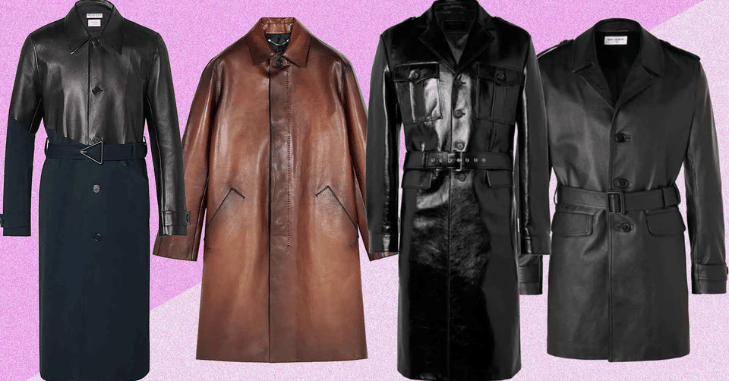
A men’s leather trench sits in a narrower band. Below the calf and in glossy black it acquires an unmistakable film-villain association that is very hard to shake off. The versions that work day to day are mid-length, matte, and in chocolate, tobacco or a dark olive rather than patent black. Cut it around 105 to 115cm, wear it over a crew-neck knit and straight trousers, and keep the belt tied loosely or left hanging. Single-breasted is easier to wear than double.
Colour: what each one gets you
Black is the most versatile and the best resale, but in a high-shine finish it is also the most likely to look cheap if the leather is thin. Chocolate and tobacco brown have been the quieter choice for several seasons and are more forgiving on warm skin tones. Oxblood and burgundy read as deliberate rather than default and work well against navy and grey. Bone, taupe and butter look wonderful and are a genuine commitment — pale leather picks up dye transfer from denim within weeks and cleaning it is a specialist job. If you buy pale, buy it knowing you will be paying to have it cleaned.
Care: rain, salt, scuffs, and the things that ruin a coat
Leather is skin. It wants moisture and it hates heat, and almost every disaster comes from breaking one of those two rules.
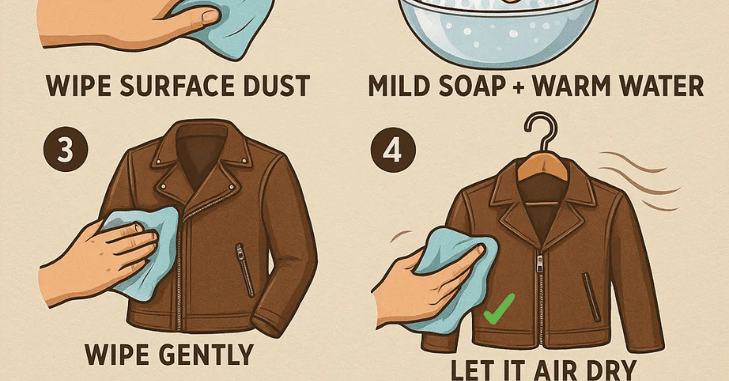
- Caught in the rain: blot with a dry cloth, then hang on a broad hanger at normal room temperature, away from radiators, fires and hairdryers. Forced heat is what makes leather go hard and crack.
- Salt marks after a slushy commute: wipe with a cloth dampened in a very dilute solution of white vinegar and water, then let it dry naturally and condition the area afterwards.
- Conditioning: a proper leather cream or balm once or twice a year, applied thinly with a soft cloth and buffed off. Never olive oil, never household furniture polish, never baby wipes on a regular basis.
- Scuffs and scratches on lambskin: many will buff out with a clean finger and body warmth alone. Try that before you try anything from a bottle.
- Never machine wash and never tumble dry any leather coat, real or faux. If the lining smells, have the lining cleaned rather than washing the garment.
- Suede and nubuck panels follow entirely different rules from smooth leather — they need a brush and an eraser, not a cream. Our step-by-step guide to cleaning suede covers the method if your coat has suede trim or a suede collar.
- Faux leather takes a damp cloth and mild soap and nothing stronger. Solvents strip the coating.
Storing it between seasons
Put it on a wide wooden or padded hanger — a wire hanger will leave permanent points in the shoulders of real leather within a single summer. Cover it in a breathable cotton garment bag, never a plastic dry-cleaning sleeve, which traps moisture and encourages mould. Give it room on either side so the leather is not compressed. Keep it out of lofts and cellars, where humidity swings are the real enemy, and out of direct sunlight, which fades and dries the surface. If it has been worn hard over the winter, condition it before you put it away rather than after, so it goes into storage supple. Anything else in the wardrobe that needs gentler handling — the knitwear you wear underneath, for instance — is covered in our guide to hand-washing clothes properly.
Alterations and repairs: what UK specialists typically charge
Leather goes to a leather specialist, not a standard dry cleaner, and not a general alterations shop. Typical UK ranges, which vary a lot by city: shortening sleeves £40 to £90; shortening the hem £60 to £120, and worth checking is possible at all, because a shaped hem sometimes cannot be raised without ruining the line; replacing a torn lining £70 to £160; a professional leather clean and recondition on a full-length coat £60 to £140; re-colouring and pigment touch-up £80 to £250. Get a quote in writing and ask whether they have done that specific finish before — a coat that has been badly re-pigmented cannot be undone.
Who a leather trench does not suit
This is an expensive coat to buy for the wrong life. Be honest about a few things before you commit.
- If you cycle or ride a scooter to work, the belt and the length are a practical problem, and repeated creasing at the hip destroys faux leather quickly.
- If you carry a heavy shoulder bag daily, the strap will wear a shiny track into lambskin within a year. A cross-body on the outside is worse than a bag carried in the hand.
- If you are mainly outdoors in heavy rain, this is not a waterproof coat. It handles a shower; it does not handle a Scottish January.
- If you run hot, leather does not breathe and you will overheat on a packed train.
- If you want one coat for everything, a full-length leather trench is a statement piece that draws attention every time you wear it. A mid-length matte version in brown is the far more wearable answer.
Buying secondhand: what to look for
The best value in leather outerwear in the UK is on the resale market, where a coat that cost £700 new commonly sells for £150 to £300 in good condition. Check five places before you buy: the elbow crease and the underarm, where cracking starts; the lining under the arms, which splits first; the belt loops and their stitching; the collar fold, where colour rubs off; and your nose, because a mildew smell in the lining almost never comes out. Coats made in the 1980s and 1990s are typically heavier and better constructed than modern equivalents at the same price, but they are also cut with a wider shoulder, which either suits you or does not. Try before you buy where you can, and factor in £60 to £140 for a professional clean when you are working out whether the price is genuinely a bargain.
Trench coats made of leather provide a special combination of durability, comfort, and style. They are made of premium real leather, like most leather coats.
Our favorite celebrities have recently shown off the countless ways to outfit leather trench coats. Tessa Thompson wore hers over a sweatshirt, pairing it with red loafers and a baseball cap for a laid-back, carefree street look.
Full-grain leather, top-grain leather, genuine leather (sometimes called premium leather), split-grain leather, and bonded leather are the five varieties or grades of leather, arranged from finest to poorest quality.
Length: While mid-length or shorter trench coats look good on smaller frames, longer trench coats are typically more attractive on taller frames. Fit and Structure: While looser fits offer comfort and flexibility, fitted jackets with contoured waistlines can highlight the figure.