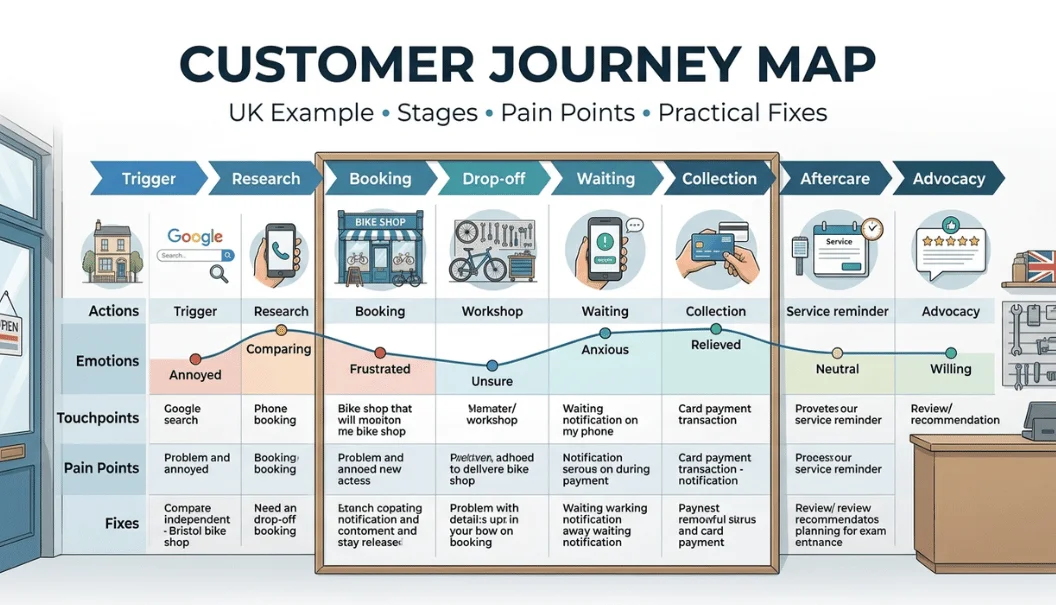
Search this topic, and you get templates. Blank grids, empty columns, a friendly note telling you to fill them in with your team. What almost nobody shows you is a finished one. So this guide gives you a complete customer journey map for a single British business, every cell filled, before it explains how to build your own. If you want to go deeper, read Ashwagandha Tincture Smells Earthy or Bitter.
Our example is an independent bike shop in Bristol. It is a composite rather than a real trading name. Every stage, touchpoint and pain point in it is ordinary, the kind you find in any small UK firm with a shop floor, a workshop and a website.
What a customer journey map is, and what goes in one
A customer journey map sets out everything a customer does, feels and touches while dealing with you. It runs stage by stage, from first awareness through to repeat purchase. Each stage records the action, the emotion, the touchpoints and the friction. The point is to find the gap between what you think happens and what does.
| Question | Short answer |
| What is a customer journey map? | A stage-by-stage record of one customer type’s experience with you |
| Rows it needs | Actions, emotions, touchpoints, pain points, fixes with an owner |
| Who builds it | Anyone customer-facing, not the marketing team alone |
| Time for a first version | One working day if your data is already to hand |
| Time if you need interviews | Two to three weeks |
| Typical UK cost | £0 in cash for an internal workshop, £475 to £900 for a facilitator |
| Sensible review cycle | Every six months, or after any change to pricing or booking |
Key takeaways
- A map without emotions is just a process diagram, and process diagrams change nothing.
- Your stages come from your business, not from the seven-stage template everyone copies.
- The useful output is not the map. It is the short list of fixes with a name and a date on each one.
- Most maps die because nobody owns them after the workshop finishes.
Five rows carry the whole thing. Actions, what the person is trying to do. Emotions, how they feel while doing it. Touchpoints, the specific places the interaction happens: a phone line, a Google listing, a card terminal. Pain points, where it goes wrong. And fixes, each with an owner and a measure attached.
Emotions are the row people skip, and it is the row that earns the map its keep. Big brands build their whole service culture around it. The way Starbucks trains staff to greet and remember regulars answers a feeling, not a process step. You cannot design that answer if you never wrote the feeling down.
Customer Journey Map Stages: Why Templates May Be Wrong for You
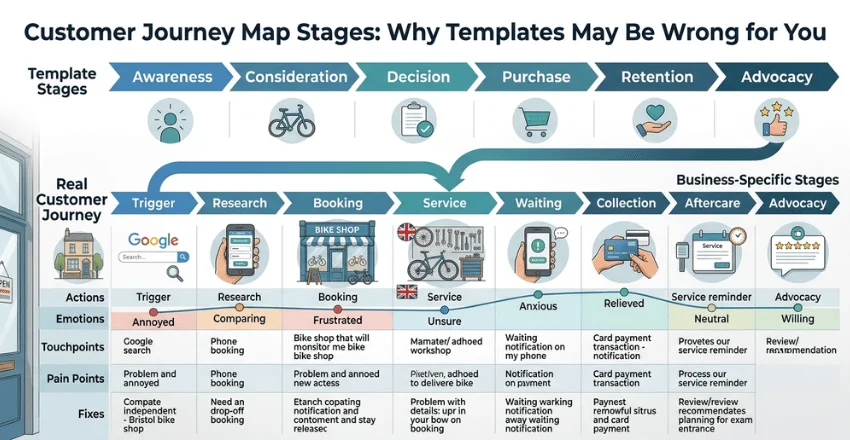
Most customer journey map templates use awareness, consideration, decision, purchase, retention, and advocacy. That works for one-off sales, but fits few businesses. Repair businesses, for example, need a trigger stage: the moment something breaks.
In B2B software, there is a procurement stage where the buyer is not the user. Dentists work to a recall stage that runs on a two-year clock. Write your stages from what your customers actually do, then check the template to see what you forgot.
A filled-in example: a Bristol bike shop
Meet Priya. She is 34, cycles four miles into the centre of Bristol most days, and bought her hybrid from this shop three years ago. Her gears started slipping on the ride home in October. Here is her journey, complete.
| Stage | What Priya does | How she feels | Touchpoints | Pain point |
| 1. Trigger | Notices the gears slipping in the dark on the way home | Annoyed, a bit unsafe | The bike, a local cycling Facebook group | No idea if this is a £15 fix or a £150 one |
| 2. Research | Searches “bike service Brist”, reads reviews on her phone | Comparing, price-sensitive | Google Business Profile, the shop website, Trustpilot | Opening hours on Google are wrong, no prices published |
| 3. Booking | Rings at 11 am from her desk, nobody picks up | Put off, ready to try the next shop | Phone line, contact form | Booking only works by phone during shop hours |
| 4. Drop-off | Wheels the bike in on Saturday, queues behind two sales customers | Rushed, unsure what she agreed to | Counter, handwritten job card | No written quote and no ceiling on the cost |
| 5. The wait | Hears nothing for two days, chases on Tuesday | Anxious, mildly ignored | Phone, email | No status update at any point |
| 6. Collection | Pays £68, taps her card, is offered a chain-waxing plan she does not understand | Relieved, faintly upsold | Card terminal, paper receipt | Slow terminal, receipt lost within a week |
| 7. After | Rides home happily, then hears nothing for 18 months | Neutral, forgets the shop exists | None | No service reminder, no review request |
| 8. Advocacy | Recommends the shop only when somebody asks her directly | Willing but unprompted | Word of mouth, Google reviews | Nothing makes recommending easy or worth doing |
What the map told the shop to change
Eight stages produced six fixes. Each one has a name against it and something countable, because a fix with neither is a wish.
- Publish a fixed-price service menu. Owner: shop manager. Measure: views on the service page.
- Correct the Google opening hours and add prices. Owner: whoever holds the login. Measure: calls and direction requests from the listing.
- Put booking online with a slot picker. Owner: the web freelancer. Measure: share of bookings taken outside opening hours.
- Text a job summary with an agreed cost ceiling. Owner: workshop lead. Measure: disputes at the till.
- Send two automated texts, “in the workshop” and “ready”. Owner: workshop lead. Measure: inbound “is it ready yet” calls.
- Reminder at ten months, review request three days after collection. Owner: shop manager. Measure: repeat bookings inside 14 months.
Notice how many of those sit at the counter rather than in marketing. Stage six alone is worth an afternoon. Slow card terminals turn a happy customer into a fidgeting one, and picking the right card machine for a small business removes a pain point no advertising spend can fix.
How to build one, in the right order
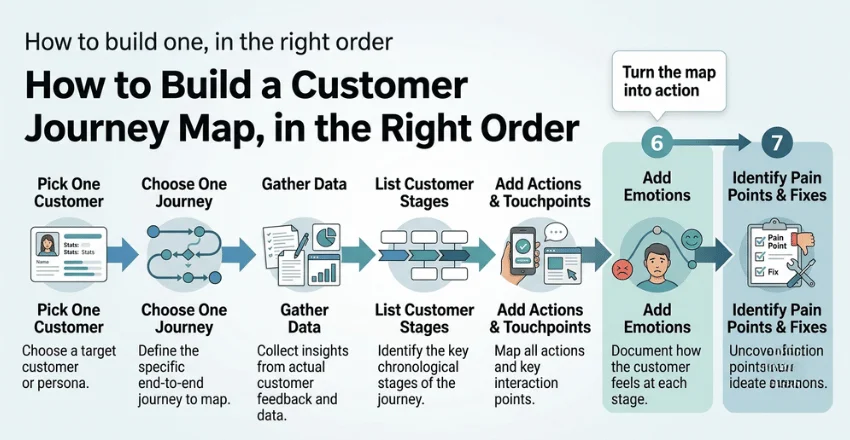
Order matters here. Do these out of sequence and you will redraw the map twice.
- Pick one customer type. Not “our customers”. One person, one situation, one goal.
- Pick one journey. A first purchase and a repair booking are different journeys. Map them separately.
- Pull the data before the workshop. Guessing at this point bakes your assumptions into everything after it.
- List the stages from the customer’s side. “Waiting to hear back” is a stage. “Order processing” is not.
- Fill in actions and touchpoints across every stage. Do this row by row, not stage by stage, so you spot the gaps.
- Add the emotions last, with the people who serve customers in the room. They will correct you.
- Mark the pain points, then choose the three worth fixing this quarter. Give each a name, a date, and a number.
Steps six and seven are the ones teams rush. They are the steps that make the difference between a poster and a plan.
Journey map, user journey map, service blueprint, experience map
These four get used as if they were the same document. They are not, and picking the wrong one wastes a day.
| Document | Scope | Best for |
| Customer journey map | One customer type, one journey, across all channels | Finding friction in an end-to-end experience |
| User journey map | One task inside one product or website | Fixing a signup, checkout or onboarding flow |
| Service blueprint | The customer’s side plus everything staff and systems do behind it | Working out why the back office keeps causing the delay |
| Experience map | The whole behaviour, brand-agnostic | Entering a market where you have no customers yet |
What data you need, and where you already have it
Small firms usually own more evidence than they think. Before you book a room, gather these.
- GA4 for the pages people land on and the ones they abandon.
- Google Business Profile insights for calls, direction requests, and the searches that found you.
- Your till or booking system for repeat rates and time between visits.
- The shared inbox and the call log, which is where pain points are written down in the customer’s own words.
- Reviews on Google and Trustpilot, read in full rather than counted.
- Six short customer conversations. Six is enough to hear the same complaint three times.
What journey mapping costs in the UK, and how long it takes
Running it internally costs nothing but time: roughly two days of staff time for a first map, spread over a fortnight. Bringing in a facilitator for a one-day session is the common middle option. Contract UX day rates in Britain sit around £475 at the median on mid-2026 vacancy data. Specialist service design consultants charge more, often £700 to £900.
An agency programme with fresh customer research attached starts in four figures and climbs. Software is the cheap part. Miro’s free tier comfortably handles a first map, and its paid plans start at about £6 per person a month, converted from the US list price. Paper and sticky notes work just as well, and they force people to stand up.
Why journey maps get ignored after the workshop
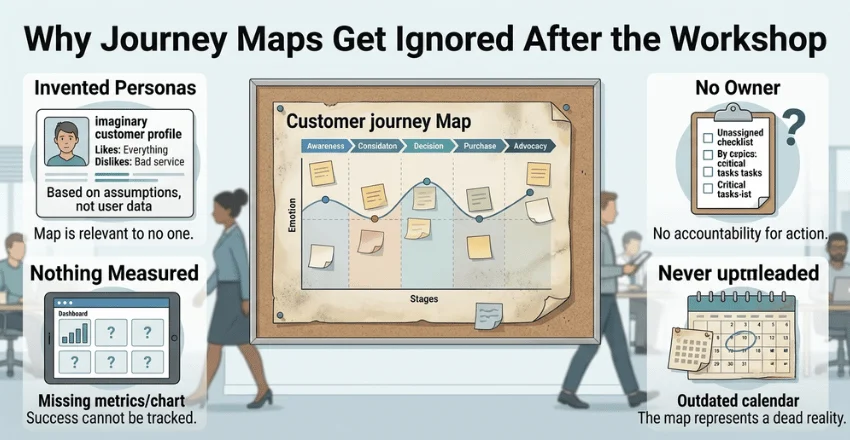
This is the honest part, and the part the template pages leave out. Most maps fail for four reasons, and none of them is a drawing problem.
The personas were invented. Colleagues describing a customer they have imagined produce a map of the company’s assumptions. It will confirm whatever the loudest person already believed.
Nothing was assigned. Workshops end with twenty coloured notes and no owner on any of them. Two weeks later, the photo is still in someone’s phone.
It measured nothing. If a fix has no number attached, nobody can say whether it worked, so nobody defends it when the quarter gets busy. Firms that already track objectives, whether on a spreadsheet or through balanced scorecard software for strategy execution, keep their journey fixes alive. The fixes survive because they land somewhere that gets reviewed.
It was drawn once. Maps drawn in 2024 describe a business that has since changed its prices, its booking system and half its staff. Diarise a review every six months and treat the map as a live document.
One more failure worth naming: mapping the journey you wish you had. If the honest answer at stage five is “we go silent for two days”, write that down. A flattering map is a wasted one.
Your next step
Block out three hours this week. Take one customer type, one journey and whatever data you already hold, and get as far as the pain points row. Then pick the single ugliest pain point and fix it before you draw anything else. Momentum from one repaired stage beats a beautiful wall chart nobody acts on.
FAQ
Stages, the persona, actions, emotions, touchpoints, and pain points. Most useful versions add a seventh column for the fix and its owner, which is what turns the document into work.
As many as the customer experiences, usually between five and nine. Fewer than five normally means you have merged stages and hidden the friction inside them.
Funnels measure how many people move from one stage to the next. A journey describes what those people are doing and feeling while they move. The funnel tells you where they drop out, and the journey tells you why.
Every six months, and immediately after any change to pricing, booking, or opening hours. Those three changes alter the experience faster than anything else a small business does.
Yes, with one adjustment. Add a column for who is involved at each stage, because the person researching, the person approving the budget, and the person using the product are rarely the same.