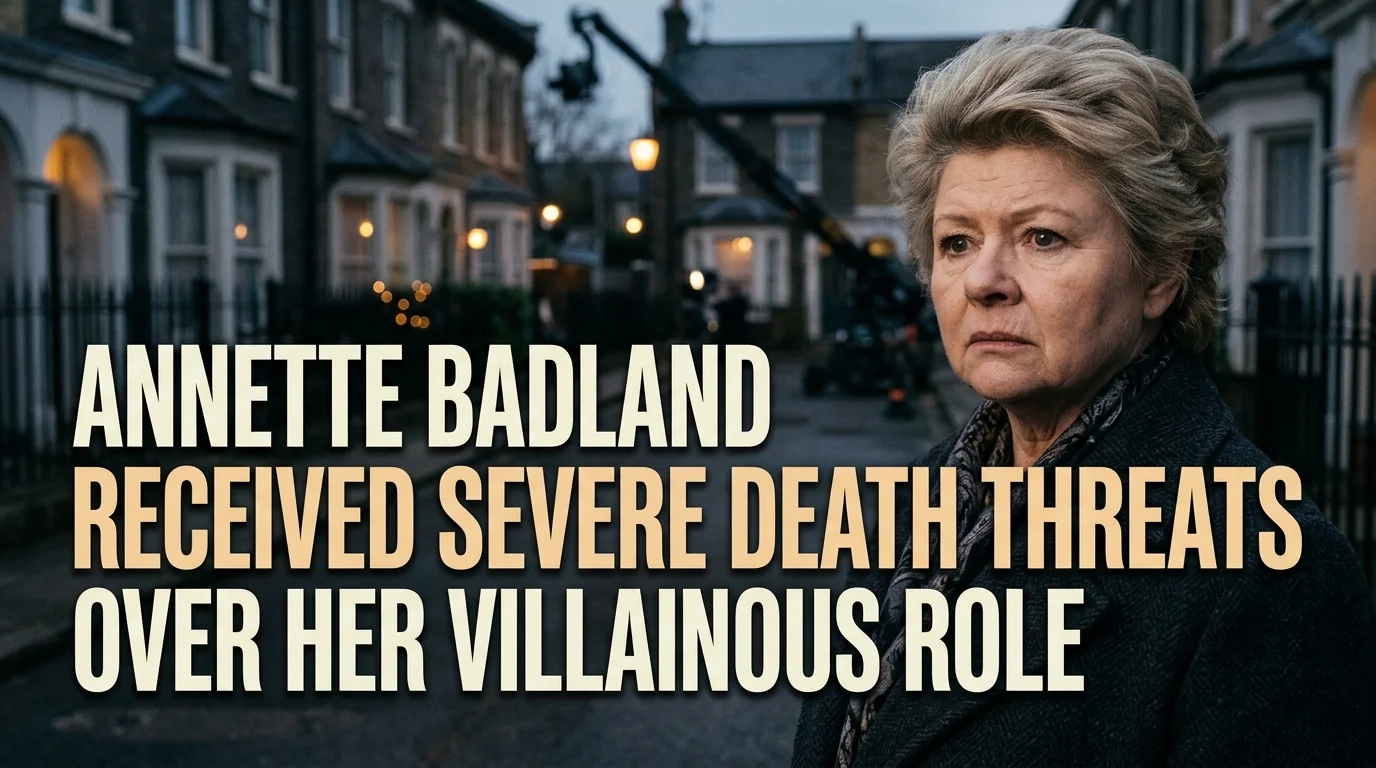
Annette Badland received severe death threats over her villainous role as Aunt Babe in EastEnders. The threats became serious enough for BBC security to warn the British actress against going out. She was also advised to avoid sharing her whereabouts or activity on social media.
Badland has now spoken in detail about the frightening period. She said security identified language serious enough to trigger a “red alert” response. The experience shows how an actor’s fictional role can sometimes provoke disturbing reactions away from the screen.
Key facts about Annette Badland and the death threats
| Detail | Information |
|---|---|
| Actress | Annette Badland |
| EastEnders character | Babe Smith, commonly known as Aunt Babe |
| Years in the soap | 2014–2017 |
| Nature of threats | Death threats |
| Security response | BBC security became involved |
| Safety advice | Stay home, limit outings and avoid revealing locations |
| Investigation | Threats were traced to a public computer near Liverpool |
| Duration | Around one month to six weeks |
| Recent disclosure | A Night In With Sally Lindsay podcast |
| Other notable work | Ted Lasso, Doctor Who, Bergerac and Midsomer Murders |
Direct answer: Annette Badland received death threats while playing the villainous Aunt Babe in EastEnders. BBC security considered the messages serious and advised her to restrict her movements. Investigators eventually traced the activity to a public computer near Liverpool, but they could not identify an individual sender.
Annette Badland Received Severe Death Threats Over Her Villainous Role
Badland played Babe Smith from 2014 until 2017. The character became known for manipulation, blackmail and destructive behaviour towards other Walford residents. Her increasingly dark storylines made Aunt Babe one of the soap’s memorable antagonists.
The actress discussed the threats during A Night In With Sally Lindsay in July 2026. Badland explained that Babe became increasingly villainous as her departure from the programme approached. Some viewers apparently struggled to separate the performer from the fictional woman she portrayed.
Badland recalled receiving a call from BBC security concerning the threatening messages. Security staff told her that the concerning language within them meant the situation had to be treated seriously. Their response changed how she could conduct her everyday life for several weeks.
BBC Security Put the Situation on “Red Alert”
BBC security involvement shows these were not treated as ordinary negative viewer comments. Badland said security personnel recognised specific warning language in the messages. That assessment led to immediate precautions while investigators tried to identify the source.
She was advised not to go out unnecessarily during this period. She was also warned not to tell people where she planned to be. Social media activity that could reveal her location was another concern.
The restrictions lasted around a month to six weeks. During their podcast conversation, Sally Lindsay described the situation as similar to “house arrest.” Badland agreed with that description and explained the restrictions placed on her movements.
Where Did the Threats Come From?
Investigators made progress in determining where the threatening communications originated. According to Badland, they traced them to a location just outside Liverpool. The activity was connected with a public computer at a school.
Badland said investigators did not believe this necessarily meant a child was responsible. A publicly accessible computer could have been used by different people. That made it much harder to identify one person behind the threats.
The investigation therefore reached a practical limit despite locating the computer. Badland said the process took roughly a month to six weeks. During that time, she continued to follow the safety guidance she was given.
Why Aunt Babe Provoked Such a Strong Reaction
Aunt Babe was designed to cause trouble within the Carter family and across Albert Square. Her storylines included blackmail, deception and deeply manipulative behaviour. The character’s actions increasingly positioned her as an antagonist before her eventual departure.
Badland has explained that writers increased Babe’s villainous behaviour before writing her out. That escalation gave viewers even more reasons to dislike the character. Yet anger towards a fictional character crossed a serious boundary when threats were directed towards the actress.
Her experience also illustrates the unusual relationship between soap actors and audiences. Regular appearances can make television characters feel familiar to viewers over several years. In extreme cases, that familiarity can blur the distinction between a performer and the fictional person on screen.
Badland Had Spoken About the Threats Before 2026

The recent podcast appearance added new detail, but Badland had discussed the threats before. In 2021, she described receiving frightening messages towards the end of her time in EastEnders. She also confirmed that police became involved.
Badland spoke about the subject again in a November 2024 interview. She said the experience was disturbing because certain people appeared unable to separate her from her character. She also described living more cautiously while the threats were being investigated.
Her 2026 comments add more information about the security response. They reveal the reported “red alert” language and the effort to trace the messages. They also clarify how restrictive the safety advice became during those weeks.
Who Was Aunt Babe in EastEnders?
Babe Smith arrived in EastEnders in 2014 as a member of the Carter family. Viewers commonly knew her as Aunt Babe. She was connected to characters including Shirley Carter, Tina Carter, and Mick Carter.
Babe initially seemed warm, but her manipulative side became increasingly prominent. Her schemes created conflict within the Carter family and affected other Walford residents. These storylines established her as a recurring antagonist.
Her final period in Albert Square pushed that behaviour further. Her actions eventually caught up with her, and she was forced out of the Queen Victoria pub. The dramatic departure ended Badland’s regular run on the soap in 2017.
The Difference Between Annette Badland and Aunt Babe
Badland’s account highlights an important distinction that television audiences normally understand. Actors portray fictional personalities whose behaviour does not reflect their own character. Playing a convincing villain is part of the performance, not evidence of the performer.
Badland has enjoyed a long career across British television, film and theatre. A guide to Tom Burke’s movies and TV shows shows how varied such careers can be. Her roles have ranged far beyond the scheming woman viewers saw in Albert Square. They include appearances in Doctor Who, Bergerac, Midsomer Murders and Ted Lasso.
That varied career makes the reaction to Aunt Babe especially striking. Badland said she had never had viewers identify her so closely with a character. The threatening response therefore represented unfamiliar and frightening territory for the actress.
What Happened After the Investigation?
According to Badland’s previous accounts, the threatening activity eventually subsided. Investigators traced its source but could not identify who used the public computer. The security precautions were eventually lifted as the immediate concern diminished.
No publicly reported information indicates that investigators identified and prosecuted an individual for the messages. The limitations surrounding a shared computer made attribution difficult. Badland was therefore left without a definitive answer about who was responsible.
Her career continued after leaving Albert Square. Other British performers, such as those in Laura Aikman’s movies and TV shows, have followed similarly varied paths. She later became familiar to international audiences as Mae Green in Ted Lasso. She has continued working across television while discussing her EastEnders experience in interviews and podcasts.
Why the Story Has Returned to Attention
Badland’s appearance on Sally Lindsay’s podcast brought the story back into UK entertainment coverage during summer 2026. The conversation contained more detail about what BBC security told her. It also explained how investigators approached the threatening communications.
The timing matters because the underlying incident itself is not new. The threats date back to the latter part of her EastEnders run, not 2026. Her latest interview is a new account of an earlier experience.
That distinction helps avoid a misleading interpretation of the story. Badland was not reporting a newly launched threat campaign in July 2026. Instead, she was recalling how serious the earlier threats became and how authorities responded.
What Annette Badland’s Experience Says About Soap Fame
British soaps build unusually long relationships between audiences and fictional characters. Actors can appear in viewers’ homes several times each week for years. Recognition can consequently become intense, particularly when a performer plays a convincing antagonist. Other soap roles have drawn similar attention, such as Michelle Keegan’s television role as Tina McIntyre.
Most audience engagement remains harmless and forms part of television culture. Threatening an actor because of a fictional storyline is fundamentally different. Badland’s experience demonstrates how quickly that behaviour can create genuine security concerns.
The BBC’s response also shows how seriously credible threatening language can be assessed. Badland was given practical restrictions while investigators worked on the case. For her, playing a successful villain briefly produced consequences far beyond the television studio.
Frequently Asked Questions
Did Annette Badland receive death threats because of EastEnders?
Yes. Annette Badland received severe death threats over her villainous role as Aunt Babe in EastEnders. She said BBC security and police became involved after they deemed the messages serious.
Why was Annette Badland told to stay at home?
BBC security advised Badland to limit her movements while the threats were investigated. She said security had detected concerning language that prompted a serious response. She was also advised not to reveal her whereabouts online.
How long was Annette Badland effectively confined to her home?
Badland indicated that the investigation and restrictions lasted roughly a month to six weeks. During that period, she was advised against unnecessary outings. The experience was later compared to being under “house arrest”.
Who sent the death threats to Annette Badland?
The identity of the sender has not been publicly established. Badland said investigators traced the activity to a public school computer near Liverpool. Because multiple people could access that computer, investigators could not narrow the source to one person.
When did Annette Badland play Aunt Babe?
Badland played Babe Smith in EastEnders between 2014 and 2017. The character became increasingly antagonistic before her departure. Her schemes made Aunt Babe a major source of conflict for the Carter family.
What other programmes has Annette Badland appeared in?
Badland has worked extensively across British television and theatre. Her television credits include Doctor Who, Bergerac and Midsomer Murders. International audiences may also recognise her as Mae Green from Ted Lasso.
The Lasting Impact of Aunt Babe
Aunt Babe remains one of Badland’s most recognisable British television characters. The role demonstrated her ability to make a fictional antagonist believable enough to provoke strong audience reactions. Unfortunately, a small part of that reaction spilled over into real-world threats.
Badland’s latest account gives viewers a clearer picture of what happened away from Albert Square. Security concerns restricted her daily life for several weeks while investigators tried to identify the source. Her story remains a stark example of what can happen when viewers fail to separate an actor from a fictional villain.
For more UK entertainment stories, television updates, and celebrity news, readers can continue exploring Writiva’s latest coverage.