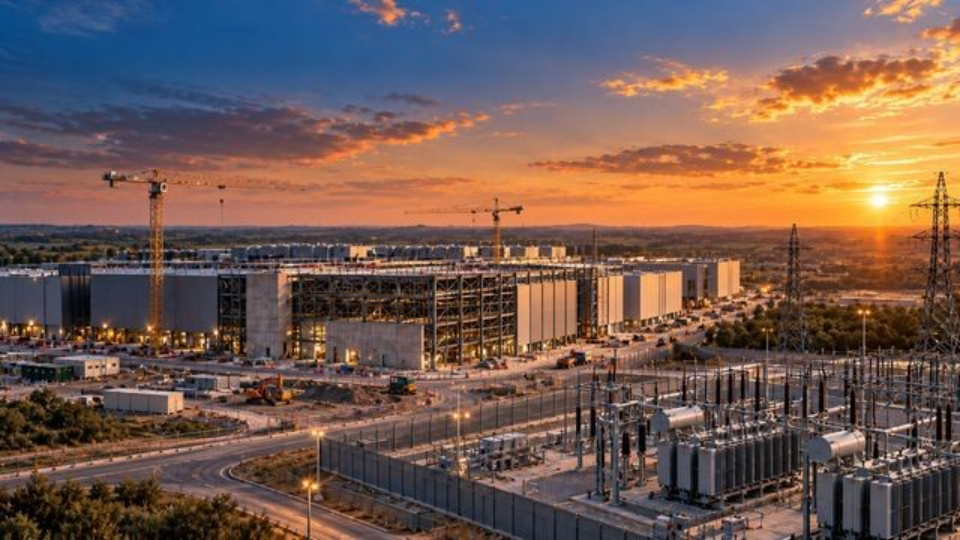
Artificial intelligence may live in the cloud, but the infrastructure behind it is unmistakably physical. Britain’s expanding AI economy is creating a new generation of data centres – and with them, demand for buildings, power networks, engineering, construction skills and materials.
| £100bn+ | 6GW | 212MW+ |
| UK data-centre construction currently planned | AI-capable UK data-centre capacity forecast by 2030 | London 2026 data-centre take-up forecast |
For most people, AI is experienced through a screen. A question is typed, a result appears, and the process feels almost weightless. Behind that interaction, however, sits an increasingly large physical system: data halls, substations, transformers, cooling equipment, fisbre networks, backup power, security systems and the buildings that contain them.
That connection between digital growth and physical construction is becoming increasingly important in the UK.
Turner & Townsend alinea reported in September, citing Barbour ABI, that more than £100 billion of data-centre construction is currently planned across the UK. The figure represents a development pipeline rather than £100 billion of contracts ready to start immediately, but its scale shows how rapidly digital infrastructure has moved into the mainstream construction conversation. [1]
AI demand is becoming construction demand
The UK Government’s Compute Roadmap forecasts that Britain will need at least 6GW of
AI-capable data-centre capacity by 2030 – roughly three times the capacity available when the roadmap was prepared. The government’s AI Growth Zone strategy is intended to support nationally significant sites capable of serving at least 500MW of demand, with at least one zone potentially exceeding 1GW. [2]
For the construction industry, the implication is straightforward: more computing capacity requires more places to house it – and those facilities are among the most highly engineered buildings being delivered today.
Commercial demand is also strong. CBRE expects London data-centre take-up to exceed 212MW during 2026, above the nearly 193MW recorded in 2025, with vacancy projected to fall to 5.5% by year-end. CBRE also expects new supply of around 185MW in 2026, supported by demand from hyperscalers and emerging “neocloud” providers. [3]
Modern AI data centres require structural capacity, dense electrical systems, advanced cooling, fire protection, resilient building envelopes, security, access infrastructure and increasingly complex mechanical systems. That creates work not only for technology companies, but for contractors, engineers, utilities and material suppliers.
A major project in Northumberland shows the scale
One of the clearest examples is the QTS data-centre development at Cambois, near Blyth in Northumberland.
Northumberland County Council says the development represents potential investment of up to
£10 billion and has planning permission for a campus of up to 540,000 square metres. The council expects the project to support around 1,200 construction jobs over several years, in addition to hundreds of operational roles once the campus is complete. [4]
The project also illustrates why the impact extends beyond the data-centre buildings themselves. In March 2026, civil engineering work began on new underground high-capacity fibre infrastructure around the area. The network is intended to connect the Cambois campus to major UK cities through a national fibre network, requiring works along highway routes around Bedlington, Cramlington and Seaton Delaval. [5]
A large data-centre campus can therefore trigger demand for site preparation, roads, fibre, drainage, power connections, substations, specialist electrical works, cooling infrastructure and building materials. The economic footprint can extend far beyond the walls of the final facility.
The grid is becoming part of the construction programme
Power is one of the most important constraints – and one of the largest infrastructure opportunities.
Ofgem reported in July that applications for large demand connections had increased from 41GW to 125GW in less than a year, driven largely by data-centre projects, which accounted for at least 80GW of the queue. The regulator has proposed commitment fees and development milestones designed to remove speculative projects and make more capacity available to viable schemes. [6]
That pressure is already translating into physical network investment. National Grid’s North West London Upgrade, launched in August, includes a new substation, around 60km of new cable and more than 200km of upgraded overhead lines. Among the new connections the programme is intended to support are five data centres. [7]
For contractors and suppliers, this expands the opportunity across multiple layers of the built environment: data-centre construction, utility work, civil engineering, transmission upgrades and the specialist systems that connect them.
What this means for construction materials
The largest cost centres in an AI data centre are often electrical and mechanical equipment, but these are still substantial buildings and infrastructure projects. They require structural systems, internal partitions, protected technical spaces, insulation, roofing, weather protection, fire-resistant assemblies, access roads, temporary works and extensive supporting infrastructure.
For the materials industry, the opportunity is not to assume that every traditional building product automatically belongs in a data centre. The more important opportunity is to understand where construction investment is moving, what specifications those projects require and how supply chains can support them reliably.
That matters because data-centre projects tend to place a premium on resilience, traceability, programme certainty and technical compliance. Suppliers that can provide consistent specifications, dependable logistics and clear product information are well positioned to participate in a market where delays can be extremely costly.
The broader materials environment is also changing. Government statistics show the UK construction material price index for “all work” was 5.9% higher year-on-year in July 2026. [8] In that environment, procurement discipline and supply-chain resilience become even more important as new high-value construction sectors expand.
A positive new source of demand for UK construction
The wider construction market remains mixed. ONS estimates that total construction output fell 0.5% in the three months to July 2026, although output increased 0.1% in July itself. [9]
That makes the emergence of new investment categories particularly significant. Data centres will not replace housing, conventional infrastructure or commercial development. But they add another large and technologically sophisticated source of construction demand – one that is closely connected to long-term investment in electricity networks, fibre, industrial facilities and regional development.
AI is creating demand for computing. Computing is creating demand for data centres. Data centres are creating demand for power and connectivity. And all of those requirements eventually become physical construction projects.
For the UK construction and materials industries, that creates a potentially powerful investment cycle.
Technology is becoming physical infrastructure
Artificial intelligence is often presented as evidence that the economy is becoming more digital and less dependent on physical assets. In practice, scaling AI requires enormous amounts of physical infrastructure.
More AI requires more compute. More compute requires more power. More power requires more grid capacity. More data centres require more buildings. And more buildings require engineers, contractors, skilled trades, equipment, logistics and materials.
The UK has already recognised data centres as Critical National Infrastructure, reflecting their growing importance to the economy and essential services. [10] The next phase of AI investment could make the connection between digital technology and physical construction even more visible.
Not every project in today’s £100 billion-plus pipeline will necessarily be built, and grid access, planning, equipment lead times and project economics will continue to determine which schemes move forward. But those constraints do not remove the construction opportunity. In many cases, solving them creates additional engineering and infrastructure work.
Artificial intelligence may live in the cloud. But the cloud has to be built somewhere.
For an industry often described as slow to digitise, there is an interesting irony: one of the technologies transforming the digital economy may also become one of the forces driving the next generation of physical construction.
At FENCYX, we follow the forces changing demand across the UK construction-materials market – from traditional building activity to emerging categories such as digital infrastructure. For builders’ merchants and suppliers, understanding where investment is moving next is becoming just as important as understanding what is being built today.